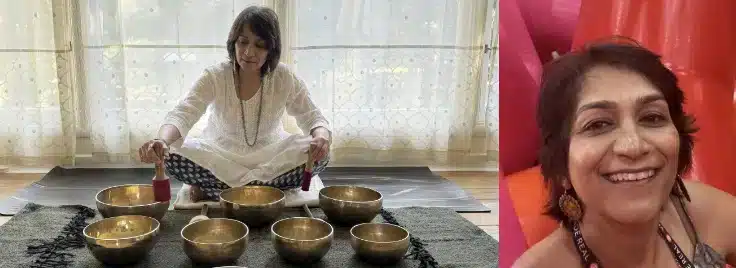
Nada Yoga, the Yoga of Sound

By Purvi Shah, RYT500

Sound is often the first sense we develop and the last to fade. It has the power to soothe, to awaken, and to transform. In sound healing, we return to this primal connection using vibration to move from the external to the internal, from noise to stillness, and from separation to wholeness.

This is the essence of Nada Yoga (Naad Yog), or Sound Yoga. Nada Yoga is divided into two aspects: Ahata (external sounds), which refers to the sounds we hear, like chanting, instruments, or music and Anahata (internal sounds), the subtler, silent vibrations of our own awareness.

To clarify further, Ahata, a struck or audible sound that is perceived through our external senses, specifically, our ears.

Anahata, unstruck or silent, internal vibrations of the self that are considered sacred and personal.

The sounds used in sound healing are examples of Ahata Nada – external, “struck” sounds such as playing Tibetan singing bowls, crystal bowls, chimes, or gongs. These audible sounds are a starting point to help you: refine focus, shift awareness inward, cultivate deep listening, and achieve calmness. They serve as a tool to eventually access our Anahata Nada, the deep, internal, sound cultivated in advance of meditative shifts.

Sound healing combined with Yoga Nidra (Yogic Sleep) creates a state of trance-like sleep where the body is in a state of consciousness between waking and sleeping. Yoga Nidra takes us inward. When I lead sessions, I make everyone aware that they might end up snoring or hear someone around them snore. Just let go.

When we can let go, surrender to the sound, stillness, and breath, we can go inwards and slow down. A sound healing session combined with Yoga Nidra reduces anxiety, promotes better sleep, and enhances self-awareness, along with energizing and improving your mood.

Moving from external sounds to internal sound awareness is a journey. As humans, we hold our fears, worries, joys, and responsibilities close. We carry them on our shoulders, in our neck and jaw, and throughout the body, each of us in different ways, depending on our physiology. We also forget to breathe. Breath keeps us alive, yet the kind of breathing that carries us through the day is different from the intentional breathing that centers and grounds us. That kind of breath does not come as easily as we might hope.

1. The simple act of closing our eyes immediately disconnects us from the external.

2. Taking a few deep cleansing breaths brings awareness to our current state of being.

3. Lying down signals a shift from doing to surrendering.

When we combine all three of these actions in a sound healing session, we open ourselves to both the external sounds and the inner vibrations that help us slow down and attune to our internal rhythms.

Science is still catching up to understanding how sound heals, but the current research is promising. A review of 400 published scientific articles on music as medicine found strong evidence that music has mental and physical health benefits in improving mood and reducing stress. In fact, rhythm in particular (over melody) can provide physical pain relief. One study published in the Journal of Evidence-Based Integrative Medicine found that an hour-long sound meditation helped people reduce tension, anger, fatigue, anxiety, and depression while increasing a sense of spiritual well-being.

This research mirrors what I witness in my own practice. At the end of each sound healing session, when we sit quietly and reflect, participants share experiences that range from slowing down to falling into deep sleep, from seeing colors to sensing a presence, from becoming emotional to entering deep calm.

As a sound healer, to witness the resonance of my seven Tibetan singing bowls filling the room, to feel the reverberations softening hearts and bodies, is awe-inspiring. Each session is not only a reminder of sound’s profound healing power. It is also a humbling teaching experience.

See details for Purvi’s in-person September 12 workshop at IYISF – Sound Healing & Breathwork

For more about Purvi, visit https://www.playrx.life/

2026-08-23T16:01:37-07:00August 24th, 2026|

How to Deepen Meditation

Swami Ramananda
by Swami Ramananda

Deepening a meditation practice requires more than simply sitting for longer periods of time. A truly effective practice depends on cultivating a sufficient level of refined energy. This energy expresses itself as alertness, mental clarity, willpower, conviction, and discrimination. These qualities make it possible to step back from the powerful stream of thoughts, emotions, and personal stories that continually capture our attention. Without them, we can remain absorbed in our mental patterns without even recognizing it—much like becoming engrossed in a mediocre movie and only later realizing that it was not worth the time and attention we gave it.

One of the most important ways to strengthen meditation is through conscious prioritization. The quality of our practice is deeply influenced by how we invest our energy throughout the day. Reflect on what you truly value and consider creating a personal mission statement that helps align your choices with your deepest aspirations. When our daily actions are guided by clear intentions, the mind becomes less fragmented and more available for inner work.

Lifestyle also plays a significant role in supporting meditation. The many choices we make regarding diet, sleep, work, entertainment, and social interactions all affect the quality of our energy and attention. Paying attention to the effects of stimulants such as coffee, excess sugar, overeating, or poor sleep can reveal obstacles to deeper practice. Cultivating pratyahara—the ability to withdraw attention from unnecessary sensory stimulation—helps conserve mental energy and creates the inner quiet needed for meditation to flourish.

Inspiration is another essential ingredient. Reading spiritual books, studying uplifting teachings, and sharing your journey with a trusted practice partner can renew enthusiasm and remind you of the deeper purpose behind your efforts. Equally important is the preparation that precedes meditation. Often, more progress comes from skillful preparation than from simply extending the sitting itself. Practices such as pranayama, a brief seated Yoga Nidra, reaffirming a heartfelt intention, or offering a prayer for guidance and support can help settle the mind and open the heart. Since willpower alone is often no match for deeply rooted emotions and attachments, calling upon a deeper source of strength can be invaluable.

Different approaches to meditation may be helpful at different times. The path of Raja Yoga emphasizes patient, step-by-step refocusing of attention and the cultivation of concentration and pratyahara. Bhakti Yoga invites us to surrender our burdens, offer them to the Divine, and rest in trust. Jnana Yoga encourages inquiry and observation—labeling thoughts, noticing recurring patterns, examining self-talk, and ultimately becoming aware of the awareness that observes all experience. Karma Yoga transforms practice into an offering, where meditation is motivated by a sincere desire to serve and benefit others.

Finally, every meditation practice benefits from periodic renewal. Participating in group meditations, attending workshops or retreats, practicing silence for part of a day, fasting moderately when appropriate, or occasionally extending the length of your sittings can provide a powerful boost. Having a friend, mentor, or practice companion with whom you can share insights, challenges, and encouragement can also make a tremendous difference. Meditation deepens most naturally when it is supported by an intentional lifestyle, inspired effort, and a community of shared aspiration.


2026-06-21T12:16:46-07:00June 18th, 2026|Tags: , , |

How Hatha Yoga Can Impact Our Minds and Transform Our Lives

by Rukmini Ando

I fell in love with Hatha Yoga at first sight. The experience of being at ease, even for a few moments, for the first time in years, was so impactful that I unknowingly made a vow to practice it for the rest of my life. Years later, I discovered Integral Yoga and learned about its six branches: Hatha, Raja, Bhakti, Jnana, Japa, and Karma. Hatha Yoga, the most well-known branch, is a powerful tool for cultivating awareness—not just in physical postures, but in everyday life.

In an asana, when we focus our minds on the sensations in our bodies and the flow of our breath, time slows down. Our bodies may seem still, but our minds are often racing. As we practice, we notice the mind wandering: anticipating movements, comparing ourselves to others, wishing for more flexibility or strength, dealing with memories that for some reason come up. Despite the internal chaos, something magical happens when we show up and follow the teachers’ instructions. We become more able to relax, breathe, and maybe even find peace.

As we continue to practice, we start to accept and honor our bodies’ limitations, we can let go of comparing ourselves to others and even with our past self, we become more aware of our thoughts, our attention in our body and breath strengthens, and we finally feel more present, we finally feel ourselves, we finally feel our own presence, our True Self. Little by little, we become more able to notice spaces between thoughts, pauses between breaths, and stillness beneath the surface. The physical postures become a gateway to inner awareness, teaching us to approach our mental and emotional boundaries with curiosity and compassion. We learn to observe our thoughts and emotions without getting swept away every single time. 

This awareness can translate to our daily lives. We can become more able to notice triggers for stress and anxiety, to learn to respond rather than react. We can develop more acceptance and detachment, navigating challenges with more ease and clarity. Hatha yoga has the potential to help us listen to our inner wisdom, honor our limitations, and embrace the present moment.

Move With Ease: Hatha Yoga for Hip Mobility & Lower Body

Join Rukmini Saturday, April 25th – 11 AM – 1 PM PT

2026-04-22T17:56:56-07:00April 22nd, 2026|

A Yogic Guide to Inner and Outer Renewal

Swami Ramananda

by Swami Ramananda

Spring marks a sacred transition—when the dark, dormant days of winter give way to light, warmth, and new growth. With the intention of making space for fresh perspective and new ways of blooming, we can consciously embrace the tradition of spring cleaning during this season.

From a yogic perspective, cleanliness extends to every level of our being: the environments we inhabit, the physical body we care for, and the subtle inner spaces of the heart and mind. Spring offers an ideal opportunity to declutter our homes and purify the body, aligning ourselves with the renewing energies of the season. In this way, spring cleaning becomes more than a household task—it is the release of accumulated burdens that encumber our lives and obscure our natural vitality.

Fasting, when approached with awareness and moderation, can support this process of renewal. It allows the body to rest, reset, and eliminate toxins that inhibit our capacity to thrive. There are many gentle ways to engage in this practice, each honoring individual needs. Even something as simple as skipping an evening meal can give the body time to cleanse and restore itself overnight.

Yet the deeper work of spring cleaning takes place within. The patterns of selfish thinking and reactive behavior leave subtle impressions in the mind and energy body, constricting the heart and limiting our capacity to experience love. When we live with the constant pressure to secure happiness, prove our worth, or win the approval of others, we create an undercurrent of tension that disturbs our inner balance.

In this deeper sense, spring cleaning calls us to recommit to practices that quiet the mind and restore us to an inner ground of peace. Through meditation and mindful awareness, we begin to loosen our identification with restless thoughts and reconnect with a stillness that is inherently whole. In that stillness, the lake of the heart becomes clear and expansive, revealing our natural connection to all of life. From this space, our actions—and more importantly, the intentions behind them—can realign with deeper spiritual values.

Instead of striving to gain love or happiness, we discover fulfillment in offering ourselves through compassion and service. We learn to forgive, releasing the subtle poisons of resentment and ill will that weigh upon the heart. We open to moments of wonder by being fully present, and cultivate gratitude for the countless blessings that often go unnoticed.

All of these practices help us shed the physical, emotional, and mental weight that burdens our being. With this awareness, we can recognize the habits and thought patterns that no longer serve us and consciously choose to let them go. In doing so, we create space—not only in our homes, but within ourselves—for a more peaceful mind and a more joyful, open heart.


2026-04-05T18:44:35-07:00April 6th, 2026|
Go to Top