How to Deepen Meditation

Swami Ramananda
by Swami Ramananda

Deepening a meditation practice requires more than simply sitting for longer periods of time. A truly effective practice depends on cultivating a sufficient level of refined energy. This energy expresses itself as alertness, mental clarity, willpower, conviction, and discrimination. These qualities make it possible to step back from the powerful stream of thoughts, emotions, and personal stories that continually capture our attention. Without them, we can remain absorbed in our mental patterns without even recognizing it—much like becoming engrossed in a mediocre movie and only later realizing that it was not worth the time and attention we gave it.

One of the most important ways to strengthen meditation is through conscious prioritization. The quality of our practice is deeply influenced by how we invest our energy throughout the day. Reflect on what you truly value and consider creating a personal mission statement that helps align your choices with your deepest aspirations. When our daily actions are guided by clear intentions, the mind becomes less fragmented and more available for inner work.

Lifestyle also plays a significant role in supporting meditation. The many choices we make regarding diet, sleep, work, entertainment, and social interactions all affect the quality of our energy and attention. Paying attention to the effects of stimulants such as coffee, excess sugar, overeating, or poor sleep can reveal obstacles to deeper practice. Cultivating pratyahara—the ability to withdraw attention from unnecessary sensory stimulation—helps conserve mental energy and creates the inner quiet needed for meditation to flourish.

Inspiration is another essential ingredient. Reading spiritual books, studying uplifting teachings, and sharing your journey with a trusted practice partner can renew enthusiasm and remind you of the deeper purpose behind your efforts. Equally important is the preparation that precedes meditation. Often, more progress comes from skillful preparation than from simply extending the sitting itself. Practices such as pranayama, a brief seated Yoga Nidra, reaffirming a heartfelt intention, or offering a prayer for guidance and support can help settle the mind and open the heart. Since willpower alone is often no match for deeply rooted emotions and attachments, calling upon a deeper source of strength can be invaluable.

Different approaches to meditation may be helpful at different times. The path of Raja Yoga emphasizes patient, step-by-step refocusing of attention and the cultivation of concentration and pratyahara. Bhakti Yoga invites us to surrender our burdens, offer them to the Divine, and rest in trust. Jnana Yoga encourages inquiry and observation—labeling thoughts, noticing recurring patterns, examining self-talk, and ultimately becoming aware of the awareness that observes all experience. Karma Yoga transforms practice into an offering, where meditation is motivated by a sincere desire to serve and benefit others.

Finally, every meditation practice benefits from periodic renewal. Participating in group meditations, attending workshops or retreats, practicing silence for part of a day, fasting moderately when appropriate, or occasionally extending the length of your sittings can provide a powerful boost. Having a friend, mentor, or practice companion with whom you can share insights, challenges, and encouragement can also make a tremendous difference. Meditation deepens most naturally when it is supported by an intentional lifestyle, inspired effort, and a community of shared aspiration.



2026-06-21T12:16:46-07:00June 18th, 2026|Tags: , , |

Svadhyaya — the Study of Spiritual Teachings

by Kia Meaux

This month, we have chosen Svadhyaya—the sacred practice of self-study through spiritual teachings. More than simply reading spiritual texts, Svadhyaya invites us to seek wisdom that reveals our deepest nature, and then to bring that wisdom fully into the way we live, think, and serve. As Sri Swami Satchidananda often reminded us, it is far better to study a little and truly live it than to read extensively without allowing it to transform us.

I often find myself highlighting passages that deeply resonate—words that seem to speak directly to something within. Yet the real gift of such moments is not simply in recognizing truth, but in embodying it. When a teaching touches us deeply, we can turn it into an affirmation—a simple, heartfelt phrase in our own words that reminds us of what is true. In this way, wisdom becomes more than inspiration; it becomes a living force that gently reshapes old patterns of thought.

We can also bring teachings into action. Contentment becomes real when we pause each day to write down what we are grateful for. Compassion comes alive when we consciously offer one or two acts of kindness. The teachings begin to move from the page into our relationships, our choices, and our everyday moments.

While recently studying the Yoga Sutras of Patanjali, I was deeply struck by the insight that so much of our suffering arises from how completely we identify with our thoughts. Then I remembered a suggestion that Asokananda shared during his visit last year. He encouraged us to begin meditation simply by welcoming whatever thoughts arise, witnessing them with openness and without judgment—a practice of gently loosening our identification with the mind. As I’ve begun working with this practice, I’ve found it profoundly helpful. It has brought a little more spaciousness, a little more freedom, and a little less getting lost in the changing currents of the mind throughout the day.

At the end of a full day, the thought of studying may sometimes feel like one more thing to do. But even a few paragraphs from The Golden Present can reconnect us with the truths we most want to live by. Each return to wisdom—however brief—plants another seed. And over time, those seeds quietly reshape not only the conscious mind, but the deeper layers of our being.

May you discover your own joyful and meaningful way to practice Svadhyaya, allowing the wisdom you study to become the wisdom you live.

2026-05-11T16:24:48-07:00May 11th, 2026|Tags: , , , |

Who Gets to Speak and Sing?

by Vivek Anand

A song is sung, and as a lyric it is also written. It is written in a voice. This voice tells us who is speaking, declaring their sentiments to the world. Whose voice gets heard the most? Sometimes we hear a lover or a devotee, one who praises, complains, laments. Sometimes we hear an anonymous voice which describes a beautiful or painful world, a voice which aspires for a better earth or heaven. And then sometimes we hear the call of a bird, the groan of the earth, the cry of the one who is crushed, a taunt by someone taking a risk in criticizing a king.

Sometimes the clay speaks to the potter:

Maati kahey kumhaar se, tu kyon raundhey mohey?
Ik din aisaa aayegaa, main raundhongi tohey!

And what does the potter’s clay say? In the above song by the 15th Century mystic Kabir, the raw clay says to the one kneading it: Why do you crush me? The day will come when I will crush you! The tables have been turned, and we are reminded that our human forms are ephemeral, that one day we too will be clay. In another song Kabir writes: Ghat ghat me panchhi boltaa. In every clay pot the bird speaks. He reminds us that despite our varying shapes, a bird, perhaps the same one, calls out from each beating heart.

The material being wrought by the craftsperson is not always expected to speak! In the Daoist text the Chuang-Tzu, translated by Stephen Mitchell, there is this line in a story about accepting ones transformation without comment:

When a skilled smith is casting metal, if the metal should leap up and say, ‘I insist upon being made into a Mo-yeh (famous sword)!’ he would surely regard it as very inauspicious metal indeed.

Songs such as a thumri, a romantic or seductive song sung by courtesans to their patrons, often have a teasing or taunting tone; they sometimes voice a complaint. This complaint is often about the unfeeling and heartless lover or about a king.

Sometimes a courtesan sings a thumri, and complains about the lover being gone all night, about the lover being cruel towards the one who pines for them. But the singer can also ask about the insensitivity of the powerful towards others who suffer:

In pairon taley, kaun kuchlaa jaa rahaa hai, morey rajaji?
Koi dekhey paavan paanv, dekhey ek nirdosh jeev ka ghaanv
Mori najariya, morey Nataraja, mori maiyya.

In the above version, a somewhat subversive thumri written by me, the singer asks the authority figure – king, a god or goddess: who are these feet squelching, pressing into the earth, my raja? Some see holy feet, but my eyes see the wound of an innocent being, my Lord of Dance, my Mother.

The question is about iconography, stories and societal practices such as caste and discrimination in which a figure is portrayed as being vanquished by the powerful, and where this is always valorized. The tradition has many answers, some metaphorical, some leaning on context. The uncomfortable questions can still be asked, both from within the traditions and from outside them, by those who benefit from the hierarchies and by those who are targeted by them.

The tone of the questioning singer is respectful, yet challenging. It is a humble inquiry perhaps. A worthy teacher is certainly to be approached humbly, but as in the Bhagavad Gita Chapter 4, Verse 34, part of the service includes asking questions, prashna.

Swami Chinmayananda’s translation of the verse goes:

Know that by long prostration, by question, and service, the wise who have realised the Truth will instruct you in (that) Knowledge.

Tad viddhi pranipaatena pariprashnena sevayaa
Upadekshyanti te jnaanam jnaaninas tattva darshinah

In other songs which I sing an anonymous person asks the kokila songbird to sing because the honeyed season has arrived, asks it to make the earth resound with its call. Or, one sings of the beautiful dark god, Shyam  Sundara, who dances with the cowherdesses, while one hears the sound of musical instruments and ankle bells.

In another, the 13th Century Sufi and master musician Hazrat Amir Khusrau sings to his teacher Hazrat Nizamuddin Auliya:

Chhaap tilak sab chheen li, mosey naina milaykey

You snatched away my identity and my forehead mark by meeting eyes with mine. This sung declaration is about love and surrender, about dissolving divisions. This is simultaneously self-effacing and a call to remove hierarchies.

When we are open to the voice of the clay, the cry of the one underfoot, the complaint of the lover, they have much to say.

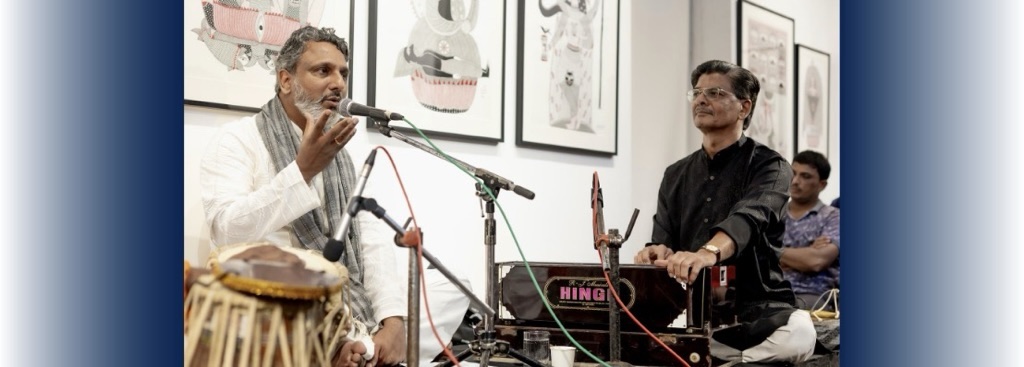
Join Vivek on Saturday, May 16 at 7:00 PM in a classical vocal concert: The Clay Speaks – Maati Kahey

2026-05-02T09:49:30-07:00May 2nd, 2026|Tags: , , |

Living with Beginner’s Mind

Swami Ramananda

by Swami Ramananda

Experiencing the Infinite Possibilities of the Present Moment

Are we truly free to act with full awareness in the present moment — in harmony with our true nature and our interconnection with all of life?

This is the heart of our spiritual experiment.

To choose freedom means learning to respond to life without being driven by the hidden “shoulds” that may have taken root in childhood. Many of these inner directives operate quietly in the background of the psyche. They are so familiar and so deeply embedded that we rarely question them. Yet they shape our reactions, our decisions, and even our sense of self.

For example, do I hesitate to admit a mistake because I fear what others may think? If my self-worth depends on approval, I may subtly distort the truth to protect my image. If I am unconsciously governed by a need for security, I may rationalize behavior that compromises my integrity. These patterns are rarely deliberate. They arise from conditioning — habitual beliefs and thought forms accumulated over time.

Yoga offers us a compassionate laboratory for self-observation.

Even on the mat, we may notice the impulse to look good, to compare ourselves with others, or to measure our practice against some internalized ideal. We may judge a class as “good” or “bad” depending on how it matches our expectations. These reactions reveal how automatically the past overlays the present.

But Yoga also gives us another possibility.

During Hatha Yoga practice, we can move with attentive awareness, tuning into the raw sensations of the body without judgment. Instead of pushing toward an image, we respond with care to our actual capacity in this moment. In meditation, we practice disengaging again and again from the stream of thought we normally identify with. As the mind grows quieter, more focused and open, it begins to perceive clearly. We respond to events as they are, rather than through the colored lens of memory, hope, or fear.

Gradually, we learn to pause.

In that pause, we discriminate between anxious reactions triggered by stress and the deeper, neutral voice of Spiritual Consciousness. This transformation does not occur instantly. It unfolds over time through steady effort, patience, and a willingness to practice without demanding specific results.

When we begin to experience moments free from habitual thought patterns, something shifts. We see ourselves — and our relationship to the world — freshly. We feel our connection with others and with all of nature. Compassion arises naturally. Wisdom no longer feels forced; it flows from a deeper place.
With continued practice, even the subconscious mind is gently restructured. Old beliefs lose their grip. We are no longer compelled to repeat familiar patterns. Instead, we approach life with a sense of belonging, inner contentment, and wonder.

This is the essence of beginner’s mind.

To live with beginner’s mind is to approach each day without being dulled by routine or distracted by constant mental rehearsal. Habit has its place — it helps us tie our shoes or follow simple procedures — but it cannot guide us creatively through the living complexity of human relationships and life’s unfolding events.

Each day offers countless opportunities to delight in ordinary miracles: the rhythm of breath, the play of light, the presence of another human being. Yet our mental landscape is often crowded with plans, goals, and future projections. Leaning anxiously toward what we hope to acquire or achieve, we overlook the quiet completeness already here.

When we release that anxious leaning into the future and meet this moment fully, we discover something profound: the present is not lacking. It is alive with infinite possibility. It contains an inherent sense of wholeness that becomes evident when we feel our connection with all things.
Every moment invites us to begin again.

And in that willingness to meet life freshly — free from conditioning, open to possibility — we align with the true spirit of Yoga: living in awareness, acting in harmony, and experiencing the boundless richness of the present.

2026-03-05T16:49:22-08:00March 6th, 2026|Tags: , , , |
Go to Top