The Spiritual Journey of Death and Rebirth

by Swami Vimalananda

He’s alive! He’s alive! What an amazing discovery! Jesus survived death on the cross and appeared from the cave alive. There are so many stories of near death experiences which end up with a person no longer fearing death. These people often report that their journey from then on is one of love, to love everything just the way it is.

We have evidence all around us of seeming death only to see rebirth: the trees dormant in the winter, bring buds, blossoms, and then leaves in spring; the wildflowers that rise out of the soil pointing out to us the glories of new life.

As I am in the throes of old age, with a slower moving and creaking body, I can see what Sri Gurudev meant when he said, “I will be a prisoner in my own body.” What freedom there is in casting off the worn-out and entering into a fresh, healthy, growing body, like a new life bursting into fullness with abundant energy and vitality. It is like a road ahead appearing to end at the horizon only to stretch out to the next horizon, the next, and the next.

It is the resurrection that shows us how Jesus led his life and offered up his body for all of us to see — it is all about love and everlasting life.

Happy Easter!

Love is the Funeral Pyre
by Hafiz

Love is
The funeral pyre
Where I have laid my living body.
All the false notions of myself
That once caused fear, pain,
Have turned to ash
As I neared God.
What has risen
From the tangled web of thought and sinew
Now shines with jubilation
Through the eyes of angels
And screams from the guts of
Infinite existence
Itself.
Love is the funeral pyre
Where the heart must lay
Its body.

Please join us for a Satsang to celebrate Easter on Saturday, April 3. On this evening, we will contemplate the spiritual presence and resurrection of Jesus as Swami Vimalananda clarifies how the same truths are found in the teachings of Yoga. We will make time for discussion and personal sharings and Swami Ramananda will offer a meditative worship ritual called puja. People of all faiths are welcome. Details HERE.


Swami Vimalananda Ma, RYT500, is an Integral Yoga sannyasi – monk. She has been involved with Integral Yoga since 1971 and Director of the San Francisco Integral Yoga Institute from 1992-2011. She specializes in teaching yoga philosophy and spiritual counseling.


Swami Ramananda is the Executive Director of the Integral Yoga Institute in San Francisco and a greatly respected senior teacher in the Integral Yoga tradition, who has been practicing Yoga for over 45 years. Ramananda offers practical methods of integrating the timeless teachings and practices of Yoga into daily life, and transforming the painful aspects of human experience into steps toward realizing one’s full potential. He leads beginner, intermediate and advanced level Yoga teacher training programs in San Francisco, and offers a variety of programs in many locations in the U.S., Europe and South America. Ramananda co-developed the Stress Management Teacher Training program with Swami Vidyananda, has trained many teachers to bring Yoga into corporate, hospital and medical settings, and has taught mind/body wellness programs in many locations. He is a certified Yoga therapist and founding board member of the Yoga Alliance, a national registry that supports and promotes yoga teachers as professionals. He is a co-founder of The Spiritual Action Initiative (SAI) which brings together individuals committed to working for social justice for all beings and for the care and healing of our natural world. His warmth, wisdom and sense of humor have endeared him to many.

2021-04-02T15:19:51-07:00March 22nd, 2021|Tags: , , , |

Yoga and MS

By K. Muktidevi Demafeliz

I was diagnosed with Multiple Sclerosis (MS) in October 1998 when I was 18 years old. I recently turned the BIG 4-0 and am currently facing a change in my condition. In August 2018, I took a true LEAP OF FAITH. I was on the Avonex injections taking a weekly shot every Friday for the last 20 years, but had to change up my game. I really took the time to think about all of the possibilities and eventually trusted my decision to transition to a different medication, an infusion therapy known as Rituxan (twice a year infusion vs. 52 shots a year). It’s too early to tell if it’s going to work for me or if it will help in the long run, but I am truly hoping for the best. *hands in prayer*

MS is known as the “invisible illness” as symptoms vary from patient to patient. Intermittent symptoms, visible and invisible, include fatigue, unsteady gait, impaired balance, disrupted walking and fine motor control of the fingers, pain, numbness and tingling feelings, bladder and bowel control, heat sensitivity, memory and cognitive issues, depression, speech and vision impairment, trouble with swallowing, and other neurological symptoms that affect mobility. I have Relapsing-Remitting MS (RRMS). MS is when one’s immune system attacks the brain/spine also known as the Central Nervous System (CNS). Studies have shown that symptoms arise at unpredictable times and can be severe when an “attack” (exacerbation) triggers. Unfortunately, there is no known cause or cure for MS, but I am hoping this new treatment will work for me and continue to stabilize my condition.

This is one of the main reasons why I sought yoga in the first place, because of my MS, but to also center and balance my mind, body, and spirit. I’ve been practicing yoga for 11 years and teaching for 7 years now. I’m continuing to strive to keep my condition stable, but between the ages of 18-23 years, I was in severely bad shape which had me in a wheelchair, a walker, and using a cane. It was a blessing that I had fully regained my mobility and ability to walk, and today I practice yoga as an “able-bodied” person would. I’m hoping this status will remain as I come into my 40s.

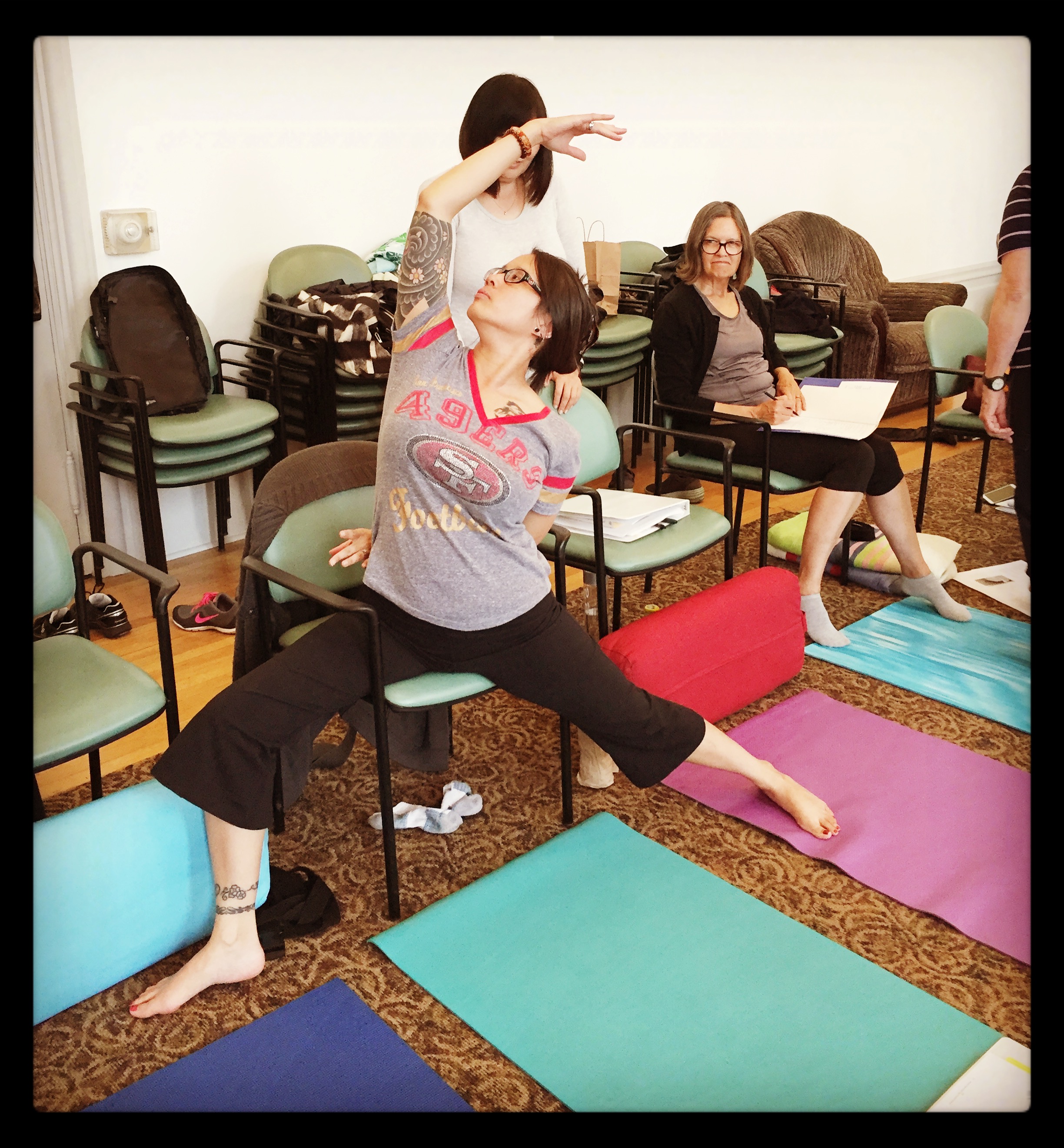
Yoga for people with MS can be such a powerful tool! There are many benefits to be gained from practicing gentle hatha yoga, especially the asanas (or poses) that can be taught in a restorative series, wheelchair or chair series, seated postures, seated/floor series, through pranayama and relaxation. This can assist with reducing fatigue, improving range of motion, improving spasticity, increasing strength, increasing coordination and balance, assisting in a patient’s confidence and calmness, as well as slowly beginning to advance with more postures specifically tailored to each student. Some of these gains could also be increased motility for digestion, increased circulation, and in many cases, significant relief from the depression that often accompanies the symptoms of MS. Yoga is not a cure for MS. I am not cured, but having my own yoga practice has certainly enabled me to handle my MS in a much more effective manner than before, and has enabled me to maintain a life that sometimes surprises me.

Yoga is valuable to people with MS for three reasons: First, the practice of yoga reduces functional deficits. Second, it increases self-reliance since it fosters independence and can be carried out independently. And third, it is one of the principal aims, in fact the principal aim of yoga, to steady and quiet the mind. Gentle, low-impact yoga is the perfect physical exercise or movement for people living with MS. I personally love a fast-paced yoga practice such a Vinyasa or Integral Yoga Flow, but it’s good that I have other alternatives to practice when I am not feeling well. Studies show that after six months of practicing yoga and learning a variety of yoga postures, one can combat fatigue, reduce spasticity, relieve stress, and increase range of motion and other symptoms, which have been significantly reduced. It is important for an MS patient to have a steady yoga practice which can self-transform and to also offer something even more important: hope.

Yoga is such a beautiful, profound, and powerful system that can assist an MS patient by empowering them to do more for themselves to the best of their ability. While yoga won’t cure MS, it can be helpful in reducing symptoms, which is enough reason to try it out if one is interested. As someone with a chronic and unpredictable illness, I know that yoga help one feel more in touch with the body as well as help them live more comfortably in it. Through postures and breathing, a steady yoga practice may improve posture, increase stamina and flexibility, and teach one how to relax and focus. There is a possibility to see positive changes in one’s flexibility and strength, even from week to week. You may not see or feel the benefits right away, but don’t let that discourage you. The one piece of advice that I give to people just starting out or rediscovering yoga: Give it a chance for at least two weeks. The first couple of sessions won’t be pretty or fluid. However, before you know it you will be doing things that you thought were impossible and feeling pretty darn good about it.


K. Muktidevi Demafeliz is a born and raised San Franciscan and has been a yoga practitioner for 11 years. Her yoga practice began with her mentor Anthony “Tony” Garcia who guided her in the study of yoga back in 2012. He encouraged her to pursue yoga teacher training, which she did, in the Integral Yoga tradition. She is certified in Basic Hatha I, Accessible Yoga (Gentle) and in May 2018 received her certification to teach Intermediate Hatha II. She wishes to pursue future trainings in Prenatal Yoga and Yoga for Trauma. YOGA IS HER PASSION and it has changed her life in such a positive and healthy way. She is a Yogini who also lives with Multiple Sclerosis (MS) for the past 21 years and continues to live one day at a time, living at her best.

2019-10-21T13:35:55-07:00October 9th, 2019|Tags: |
Go to Top