The Three Secrets of Spirituality

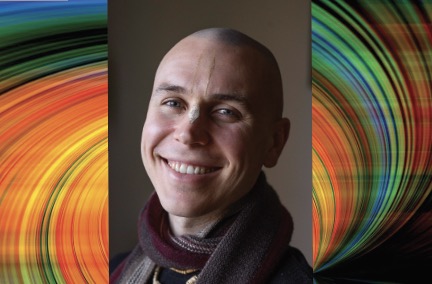
by Ekachakra Prana Das

A Personal Journey

All at once, bright lights and tripod cameras turned to face me. A devotee swung the boom mic; it was time to speak. A large group of university students were in attendance, curious about the spiritual tradition practiced in this unassuming building at the edge of campus. As a visiting monk and traveling musician, they wanted to hear my story. I opened with a brief meditation to harmonize everyone. 

First, deep breaths and body awareness, simply being. Then, finding the heart, holding a loved one there, feeling. Then focusing on the mind, asking the big questions, “Who am I? What do I really want?” Knowing. Lastly, finding the voice and chanting the mantra AUM, all together in a beautiful vibration. Doing. We exist on all these levels, and more. Yoga and meditation help bring us to a state of wholeness. The consciousness of the room changed drastically in less than three minutes. 

Then, I told my story. Raised Catholic, confused by unanswered questions. Studying the world’s religions and philosophies. Building a business, traveling as a musician, teaching yoga, writing. Meeting my mentor at a Kirtan in Nashville, and receiving the Vedic wisdom literatures. Diving deep into this comprehensive, beautiful, scientific exposition of the meaning and goal of life. And now, as part of an international society, traveling to centers across the world teaching, singing, and serving.

Everyone got a Bhagavad Gita, Krishna’s song. I explained how so many great personalities have found inspiration in these pages – Emerson, Thoreau, Gandhi, the Beatles, MLK Jr, Einstein, and many more. I told them how this jewel of wisdom has been translated hundreds of times into English, and how Prabhupada’s version has been most accepted in major universities, as he faithfully delivers the essence of Krishna’s message. We talked about karma, transmigration of the soul, the equality of all living beings, and different types of yoga and meditation. We talked a lot about God.

I shared the three secrets of spirituality I have learned along the way. The first secret? Read Srila Prabhupada’s books. They represent the original Vedic knowledge, preserved in an unbroken chain of self-realized teachers, back to God himself. The second secret? Chant the maha-mantra. All of the Vedic literatures point to the Hare Krishna mantra as the most powerful practice in this age, a transcendental formula to cleanse the heart, calling out intimate names of our original conscious source. Secret number three? Share the process with others. Join the international community, find your teachers, your friends, and your students. Distribute love of God, teach spiritual values, and save the world. 

After the talk, they asked me to lead kirtan. I grabbed the harmonium, and sang a simple, classic, heartfelt minor melody: Hare Krishna, Hare Krishna, Krishna Krishna, Hare Hare/ Hare Rama, Hare Rama, Rama Rama, Hare Hare. With Bhakta Hari Ramesh on mridanga, the karatalas ringing in perfect time, and 20 voices rising and falling like an ocean of love, we reached tearful states of transcendental ecstasy before the temple’s glorious deities, Sri Sri Radha Natabara. Building slowly yet surely, exaggerating dynamics, and mustering as much flavor as I could, we built it up, and then blasted off. 

After the class and kirtan, I felt everyone was in a rarefied state of bliss, all smiles and friends. We honored heaping plates of prasadam and laughed together in a circle on the floor. Nitai Chand Prabhu asked me to stay permanently, but I plan to continue down the road tomorrow. Leave on a high note!

Ekachakra Prana was a touring musician and yoga teacher searching for God when he met Indradyumna Swami, who invited him to travel the world in his Kirtan band. Over the next several years he wrote books about his experiences living in bhakti yoga ashrams and traveling to Kirtan festivals around the world. He recently settled in Silicon Valley at the request of his spiritual teacher, Vaisesika Dasa.
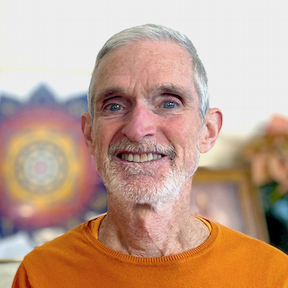
Join us for Kirtan with Ekachakra Prana & The Bhakti Band on Saturday, December 9 @ 7:00 pm – 8:30 pm PST

2023-12-04T12:11:06-08:00December 4th, 2023|

Teaching of the Month : Self-Reflection as a Spiritual Practice

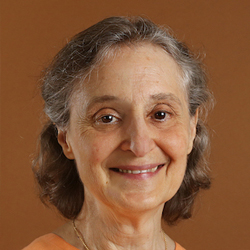
by Swami Ramananda

As the daylight hours shorten in the northern hemisphere this time of year, it’s natural to spend more time indoors. Plant and animal life alike pause from growing and withdraw from activity. We too benefit from periods of rest and reflection as a preparation for the next seasons of growth, and with the surges in COVID-19 cases, retreating from interactions has become critical to our health.

As spiritual aspirants, pausing to reflect on our behavior, and the thoughts and motives behind it, are an essential part of the spiritual path. Increased self-awareness enables us to disentangle ourselves from the habitual thought patterns that cloud our vision.  Then we can uncover the roots of our suffering and expose the unconscious beliefs that are the seeds for frustration and struggle.

There are significant obstacles to reflecting this way. Taking an honest look at the difficult moments in our lives can be challenging. Allowing ourselves to feel the sorrow or anxiety in our hearts is painful and can make us feel ashamed or depressed. For many of us, acknowledging our struggles threatens the image we are trying to live up to and project to others.

Instead of stopping to reflect on a moment of discomfort, we may simply divert our attention to some form of entertainment or escape, like checking messages or social media. In this digital age, our senses are constantly drawn outward by our numerous devices, making it easy to ignore feelings of angst or upset, and leaving no time to understand the reasons behind them.

One way to support an effort to sincerely look at ourselves is to talk with a trusted friend or therapist, someone with whom we can be completely honest. We may need the safety of their genuine care to allow ourselves to look in the dark corners of our hearts and allow ourselves to explore painful emotions. When we are able to release our anger or grief, we can often see the unhealthy expectations or desires that gave rise to it.

For example, we all like compliments and it can be insightful to see how easily we become angry or hurt when we are criticized. Looking objectively, we can see how our desire to be liked or admired compels us to go to great lengths to make ourselves look good or protect our self-image.

Writing regularly in a journal is another beneficial practice for self-reflection. Knowing it is only for our eyes, we can train ourselves to bare our souls without fear. We can experiment with giving a voice to our confusing feelings to see what lies beneath the compulsive behaviors that even we may not understand. What hidden need might compel me to twist the truth, fall again into an addictive habit, take more than my share, or blurt out some hurtful words?

A regular meditative practice makes it possible to stand apart from our own minds with enough mental strength and clarity to ask such questions. Meditation develops the neutral awareness needed to analyze our behavior without identifying with or rationalizing it. Only with such mindfulness will we be able to catch ourselves before reacting on impulse and slow down enough to make a conscious choice instead.

Making conscious choices is the only way we can expect to keep our balance and maintain a positive frame of mind in a world full of ever-changing circumstances beyond our control. We empower ourselves not by successfully controlling things around us, but by choosing to think and act guided by the deeper voice of the Self that keeps our hearts open and free of selfishness.

Taking time to reflect need not only apply to difficulty. Reflecting on the many gifts we have received keeps the difficulties in perspective and reminds us of how blessed we are. Keeping the big picture in mind – knowing we are safe, relatively healthy, and have more than adequate food and shelter – exposes the petty nature of many of our problems.

And if we are serious about wanting to experience the unchanging peace that is our birthright, we must welcome the suffering that challenges us to seek it. Looking deeply, we have the opportunity to see how much of our pain is self-inflicted, often from clinging to things that don’t last. Letting go of our efforts to arrange for some form of external happiness, we are free to experience the natural joy that comes from accepting what life brings us. Letting go of judgment, we are free to more fully extend loving acceptance to ourselves and each other.

Join Swami Ramananda for some upcoming events: Satsang: Life Can Be Fun, Sat. November 4 @ 5:30 pm – 6:30 pm PDT or his monthly Tuesday Tea Time Series, Tue. November 14 @ 11:15 am – 11:45 am PST.

Swami Ramananda, C-IAYT, E-RYT 500, is the Executive Director of the Integral Yoga Institute in San Francisco, C-IAYT, and a greatly respected senior teacher in the Integral Yoga tradition, who has been practicing Yoga for over 45 years. Ramananda offers practical methods of integrating the timeless teachings and practices of Yoga into daily life, and transforming the painful aspects of human experience into steps toward realizing one’s full potential.
He leads beginner, intermediate and advanced level Yoga teacher training programs in San Francisco, and offers a variety of programs in many locations in the U.S., Europe and South America. Ramananda co-developed the Stress Management Teacher Training program with Swami Vidyananda, has trained many teachers to bring Yoga into corporate, hospital and medical settings, and has taught mind/body wellness programs in many locations. He is a certified Yoga therapist and founding board member of the Yoga Alliance, a national registry that supports and promotes yoga teachers as professionals. He is a co-founder of the Spiritual Action Initiative (SAI) which brings together individuals committed to working for social justice for all beings and for the care and healing of our natural world. His warmth, wisdom and sense of humor have endeared him to many.

2023-10-11T21:03:04-07:00October 11th, 2023|

On Forgiveness

By Swami Karunananda

Reprinted from the August, 2013 IYTA Newsletter

There’s a saying, “To err is human, to forgive is divine.” Mahatma Gandhi was once asked how he could put up with all the injustice and cruelty in the world. He responded, “I’m such a scoundrel myself, I have compassion for all the other scoundrels in the world.” When we consider our own weaknesses and mistakes, and how hard it is for us to change, shouldn’t we be more compassionate and forgiving to others? Sri Gurudev used to say that when we point a finger of accusation at someone else, there are three fingers pointing back at us, and there’s one, the thumb, standing up— like God—witnessing everything.

Sri Patanjali in the Yoga Sutras speaks of tapas, which means accepting pain as help for purification. All the annoyances and difficulties, injustices and ordeals, make us strong. We are like gold being purified. The problems chip way at the dross in our personalities so that the true gold in us, our divine image, can shine forth. A saintly person once described it this way: “There are two types of people in the world: the saints and the saint-makers.” In other words, there are those who are sent to inspire us, and those who come to purify us. So, the next time you start to get annoyed at someone who pushes all your buttons, thank them instead for showing you your weaknesses and helping you to grow stronger.

The Tirukkural advises: “At all times put up with the excesses of others; to forget them at once is even better.” You may ask, “How is it possible to forget when someone has wronged you?” There’s a story about a spiritual teacher, who, as a boy, had a classmate that treated him very cruelly. Years later, the former classmate came to visit the teacher, where he was received with much kindness. After a while, he asked the teacher, “Don’t you remember how badly I treated you when we were boys?” The teacher gently replied, “I distinctly remember forgetting it!”

Forgiveness is an act of choice. It is not about denying, condoning, or excusing hurtful actions. Rather, it is the letting go of resentment or revenge, even when they seem warranted, and offering instead mercy and love. By so doing, we release the past and let go of negative thoughts and feelings. We become unstuck and can move on in our lives. Energy that was tied up within us becomes available for positive, creative endeavors. Relationships are healed, and we, too, are healed.

Forgiveness and healing are linked. In speaking of forgiveness, the Holy Bible says: “Forgive us our trespasses as we forgive those who trespass against us.” When we forgive others, the spirit of forgiveness flows through us, and we, too, receive the benefit. It’s like using a funnel to transfer honey from one vessel to another: the funnel also gets the sweetness. We transfer the honey of divine forgiveness to another, and we, too, are forgiven.

I once met a woman who, twenty years prior, had been diagnosed with terminal liver cancer. As she was about to undergo aggressive therapy in the hospital, she began to reflect: “Maybe I’m going to die soon, but I don’t want to die like this.” She left the hospital and rented a small cabin. She spent her days visualizing being filled with forgiveness and letting go of anger. That was her entire treatment protocol. Little by little, she felt her strength return. Within a year, she returned to her home and resumed her work. And today, decades later, she is leading a healthy, dynamic life.

Consider the alternative: We hold on to feelings of anger, resentment, and betrayal and make our lives miserable. These negative feelings poison our system and set the stage for serious illnesses. In Chinese medicine, for example, liver problems are associated with anger. If we cling to our pain, to the wrongs we feel we have suffered, we build walls around our hearts. We imprison ourselves and feel the agony of separation, loneliness, and alienation. It’s as if we shut our windows and doors and then cry that we can’t see the Light.

Forgiveness issues can occur on three levels. First, there are the people or events that we need to forgive. Next, there are those from whom we need to seek forgiveness. Lastly, we may need to forgive ourselves for perceived weaknesses or failures. The following exercises offer some suggestions on how to proceed.

Forgiveness Exercise #1

Here is a good exercise to inspire you to forgive others. Begin by purchasing a bag of potatoes. Next, make a list of every person or situation you have not forgiven. For each entry on your list, place one potato in a sack. Carry that sack with you wherever you go for one week. Physically, you will feel the burden, and that pales compared to the subtle energy drain on your system caused by all grievances and unresolved issues you are carrying. After some time, the potatoes may even start to mold and rot. Then, you’ll get a glimpse of how this inner fermentation is preventing you from experiencing the divine fragrance within.

Forgiveness Exercise #2

We may also need to ask for forgiveness. Asking for forgiveness, along with sincere repentance, can heal us, as well as our relationships. Sri Gurudev addressed this point when speaking about reversing cancer. He said if you want to heal the body, you need to burn out the karma that caused the problem. Even if you don’t know what you did, there is something you must have done to create the situation. To burn out the karma, do a lot of repentance. If you know whom you hurt, go to that person and ask forgiveness. If you don’t know what you did, or if it’s not possible to contact them anymore, mentally ask for forgiveness. You could even place a picture of the individual before you and offer your prayers in that way. By such actions, you can purge negative karma and reduce suffering in your life.

Forgiveness Exercise #3

Sometimes, it’s easier to forgive others than it is to show the same compassion toward ourselves. We can be our own toughest critic and judge. Many years back, when I was living at Yogaville West in Lake County, California, I was troubled by an interaction that had occurred with a guest several years before. There’s a saying in the Hindu tradition: “Atithi Devo Bhava,” which means, “Treat the guest as God.” God comes to the home in the form of a guest. On one occasion, I had not been very kind or gracious to a visitor, and every time I sat to meditate, remembrance of that event flashed through my mind and disrupted the sitting. One day, burdened and frustrated in this way, I came up with a plan. I couldn’t go to them. So, I decided to design a penance for myself to be executed over the course of a month as an act of atonement. It was challenging, but, with some effort, doable. In my heart, I asked God to please accept my penance.

Those were the “pioneer days” of the IYI. We had little in the way of financial resources and lived very frugally; rarely did we have special treats. The room I occupied was in a solitary location, not frequented by others. With some difficulty, I completed the month. On the very last day, when I returned to my room that night, there was a surprise awaiting me. In the center of my altar, wrapped in gold, was a huge piece of chocolate! I took it as a sign that my penance had been accepted.

We are the ones that forge the chains that bind us, and we also hold the keys to set ourselves free. Forgiveness is one of those master keys. Use it, and watch the love and light in your life grow ever brighter.
Swami Karunananda is a senior disciple of Sri Swami Satchidananda, the founder of Integral Yoga, Satchidananda Ashram, and the Integral Yoga Institutes and Centers. With over forty years experience teaching all aspects of Yoga, Swami Karunananda is one of Integral Yogas master teachers. She specializes in programs that focus on the science of meditation, the philosophy of Yoga, Yoga breathing techniques for better health and well-being, and personal transformation.

2023-09-11T20:58:24-07:00September 11th, 2023|

Can We Share Yoga with Those Who Resist It?

by Chandra/Jo Stagmmato

My discovery of Yoga and meditation when I was 18 and a college freshman began to change me from an angry and troubled teenager who hated phys ed to a balanced adult comfortable in my body. It took years, of course, for the practices to take hold. But I stayed with them, or, more accurately, returned to them in my 20s and 30s and 40s whenever I needed to be rescued from my negativity and destructive habits.

Then in my mid-40s, I stumbled into Integral Yoga. The Hatha Yoga classes were a revelation. I knew the basic poses but the more subtle practices of deep relaxation and pranayama were newer to me. Never had I felt so peaceful and free, so spacious in body and mind as I did floating out of Integral Yoga. I became a teacher and ended up working at Integral Yoga Institute of New York for more than 20 years where I studied the Sutras and the Gita, read the Golden Present on a daily basis and applied the teachings of Yoga to how I conducted my life, at least most of the time.

Sharing these practices and teachings with willing students is joyous and easy. More challenging is trying to convince some of the people in my life that the valuable lessons I learned about peaceful interactions and healthy lives might make their lives better–and mine easier if they would only become Yogis! I was certain if only my husband would do just a few poses (selected by me, of course!) each day, his back pain would subside, and if he would only adopt some Raja Yoga teachings, we would argue less. If one of my oldest friends would calm down and practice some pranayama (“I already breathe!” she angrily replied to my admittedly sometimes pushy suggestions), her hips and shoulders would feel better and she would stop being angry and resentful in her life.

Bottom line: nothing worked on either of these dear people. Furthermore, my equanimity was actually sometimes a source of friction between us. In advocating for peace and health and comfort and love, I was perceived as a bit superior and off-putting.

What can we do as Yoga teachers and enthusiastic, dedicated practitioners to address the desire to share, the frustration of resistance, and the courtesy of honoring people where they are?

Here’s what I do, with varying degrees of effectiveness depending on the day. First, I go deeper into the practices of Integral Yoga that have literally transformed my own life. The daily practices. My body and mind depend on them and on the rare days that I miss, I am reminded why these are called “daily.”=

Second, I try to look at every situation through the lens of all of the teachings to explore how I feel, what my mind is bringing up, and how I can use the great tool of a deep breath before responding to anything. With this foundation, I try to be humble, not a model or icon, but simply an example of the value of these teachings. When people say to me, oh, you look good, or, oh, you seem happy and relaxed, I have finally learned to merely say, “That’s because I practice Yoga.” Following this sentence, I clamp my mouth shut to avoid saying, “You should try it.”

Though I can’t seem to get my folks to practice asana or breathe or meditate, I have had some success in improving our communication utilizing the skills of Yoga. It’s easier now for me not to retort to a sharp remark with another one, not to visibly wear my feelings on my face, and even not to silently think a harsh thought. It’s easier for me to listen and to carefully choose my words when trying to convey something that is important to me in the hopes that the clarity and precision we learn in Hatha practice can also apply to spoken thoughts. This almost always softens the other person because it takes two to fight.

Talking simply about stretching as a generic idea without using the word Yoga made some inroads with my husband. I notice he stretches more, not in any organized way, of course, but at least there’s a stretch now and then. As for my friend, I bought her a gift certificate for one session with a wellness practitioner who is also a Yoga Therapist, though again I did not use the word. She feels somewhat obligated to go. When she thanks me, I will say the best thanks would be for her to book a second (and third) session.

Questions for reflection:

  1. Please share your own experiences in trying to share Yoga?

  2. Why do we think people are so resistant to something we know is so good?

  3. What can we do to accept people where they are rather than where we want them to be?

Chandra/Jo Sgammato is a certified beginning and intermediate level Integral Yoga instructor, who is also certified in Therapeutic Yoga with Cheri Clampett. She has served in many capacities at the Integral Yoga Institute of New York since 1999, including most recently as the Executive Director. Chandra currently serves on the Integral Yoga Global Network and the Integral Yoga Therapy Certification Governing Board. She is the founder of IYI’s Yoga At School™ program, whose mission is to bring the health-enhancing, peace-inducing practices of Integral Yoga into New York City public schools, and the director of the organization’s Yoga At Work® program.  A former book publishing executive and bestselling author, she has done extensive research on the inspiring founding, history and worldwide reach of Integral Yoga. With her belief that Integral Yoga IS Yoga Therapy and Yoga Therapy IS Integral Yoga, Chandra is honored to help facilitate the certification of more Yoga Therapists through this program.

2023-07-31T11:11:03-07:00July 31st, 2023|
Go to Top