Integral Yoga Hatha and Mental Health

by Louis Mahadev Carlino, MA, LPC, E-RYT 500

Most ancient theories of health and well-being include balance as a core concept. You can think of Yin/Yang in the Chinese system; even in the West, the Greek philosopher Aristotle writes: “Both excessive and deficient exercise ruin bodily strength, and, similarly, too much or too little eating or drinking ruins health, whereas the proportionate amount produces, increases, and preserves it.”

In the Yogic tradition we have the concepts of Ha/Ṭha, which literally translates as Sun/Moon, and corresponds directly with the Yin/Yang of the Chinese system. Ha or Yang is portrayed as masculine, active, warm, energetic, and expansive. It represents the energy of the sun. Ṭha or Yin is characterized as feminine, receptive, dark, cool, soft, still, and contemplative. It represents the energy of the earth and moon.

In all the systems which see balance as a fundamental to well-being, the opposites are not in opposition but work complementarily to create a coherent order. Take a tree, for example. Its roots go down, deep into the earth, absorbing and receiving nourishment from the soil. Without the root system, or its Ṭha aspect, a tree could not branch out fully and expand toward the sky and sun and express its Ha aspect. The two complementing energies allow a tree to be a tree.

The same complementary relationship of Ha and Ṭha plays out in us. Think of the opposing but balancing relationship between the sympathetic and parasympathetic nervous systems. Our mind and body can also be seen as opposites forming a complementary relationship. The mind is Ha in nature and tends to rise to the head. The body is seen as Ṭha and finds its ground through the legs and feet. Although the term we use is ‘mental’ health, the energies of both the mind and body must be balanced for mental health to be well-established. The balance implicit in the very name Ha/ṭha Yoga includes practices that result in balancing and harmonizing the mind and body.

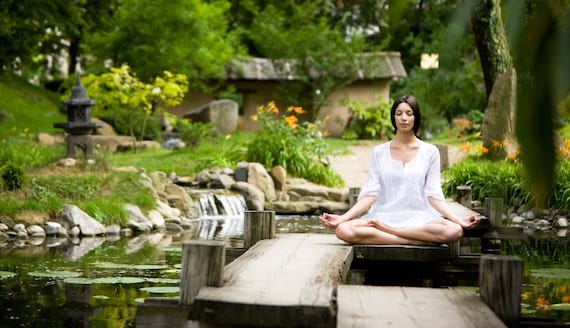
In each of the sections of an Integral Yoga Haṭha practice, from āsana (physical postures) to prāṇāyāma (breathing practices) and culminating in meditation, the principle of mind/body balance is at work. Through the lens of the Integral Yoga Haṭha practice, this article will focus on the potency of Haṭha Yoga to bring the mind and body into alignment. It is a premise of this article that a mind in balance with the body is an essential feature of mental health.

The Dilemma

In the year 2023, what ails most of us is too much mind. Our default is to overthink. Stuck in our heads, we lose connection with the subjectivity of our bodies, and we no longer truly feel our feelings or make direct contact with who we are. Instead, we are left with a mental construction of ourselves, a more rigid, inflexible pseudo self, that overly identifies with how we are perceived by others. This kind of self no longer inhabits or feels connected to the body. Instead, this self relates to the body as an object, something to be seen by ourselves and others, but not internally felt.

Here is an example that illustrates this mindset. Imagine that you’re getting ready for an event. You’re in front of a mirror. Maybe you just blow dried your hair, maybe you’re applying make-up, or just checking out the outfit you’re wearing as it’s reflected back to you. When you relate to your body in this way, you’re experiencing your body as another would experience it, not internally, but from a distance. If you like what you see, being in front of a mirror is a whole lot of fun, and presenting your image to the world is equally exciting. If you’re not as pleased by what you see, the entire experience can be very painful. Whatever the judgement, in this frame of mind, at least for the moment, you’ve become an object to yourself. While it is important to care about how you look and present yourself well in public, if you’re not able to reorient back to yourself as a subject, you will present yourself to the world equally as an object, and likely be treated as an object in return. If this mindset persists, you run the risk of falling victim to being a person defined solely by how the world perceives and judges you (whether that judgement is positive or negative). Your value as a person will then be decided by others, and you’ll lose touch with the direct experience of your own intrinsic worthiness.

If we bring our awareness back into alignment with what our bodies are experiencing moment-to-moment, our sense of self will be embodied and not be just a theory, not just a complicated web of ideas we have about who we think we are. In other words, we’ll feel who we are (intrinsically worthy), and this felt sense of ourselves will be the center out of which we relate to the world. This embodied self will be more adaptive and conscious of the feelings and impulses that arise in response to life’s changing circumstances, and so our choices and actions will be more flexible and be felt as more authentic.

The Resolution

Integral Yoga Haṭha has a reputation of focusing on the internal experience while practicing an āsana and less on the external form. As in the example of the mirror above, the external form is visible and can be seen by others. When we identify with the external form of an āsana, again, we run the risk of becoming an object to ourselves, and to others. We also fall prey to judging our practice by how we appear, and not by the quality of our inner experience.

Most beginners come to Haṭha Yoga more focused on the external. Many more shy away from Yoga altogether because they conclude that they wouldn’t be good at it, meaning they wouldn’t be able to bend forward enough to touch their toes, for example. As beginners are guided and grow in their practice, they learn to draw their awareness inward. As they progress, they gradually become more sensitive to the inner experience of their practice and realize that the true advancement/adventure in Haṭha Yoga is becoming ever more sensitive to this subtler internal dimension.

By going inward, not only is the practitioner able to adjust the external form through the inner feel of an āsana, and truly perfect a pose based on their own unique body, but an entirely new realm of experience opens. In addition to becoming sensitive to muscles stretching or strengthening, or the rate and texture of the breath, or even the quality of thoughts, all of which become apparent when awareness is drawn inward, the practitioner’s sensitivities gradually deepen, and an entirely new and transformational experience of the body occurs. The practitioner comes into direct contact with the experience of aliveness that pervades the body. This experience of aliveness and the body itself become indistinguishable. From this more direct vantage point, the body is no longer experienced as an object but as a field of vital energy, not a solid thing at all. This is the real body; not the body reflected in a mirror, seen in a photo, viewed from the outside, or judged by some external standard imposed by yourself or others.

At this level of experience, the mind is no longer lost in thought, distracted, disconnected from real life, but is now in the same place as the body. In fact, absorbed in this experience, the question of whether you’re experiencing the mind, or the body is not really a valid one. An accurate description here would be that the mind is in the body and the body is in the mind. In other words, they’ve become aligned, and the opposites are not in opposition but blend to form an integral whole.

By turning awareness inward during practice, we sensitize ourselves to inward sources of strength that extend into every aspect of our lives. The experience of aliveness is in essence tapping into the power of Life itself, no different than the power one might intuit through nature; for example, standing before a rushing body of water, or sensing the power visible in a big tree with a big trunk soring upward into the sky. You could say that what connects us to nature is recognizing that the power felt inside us (through our bodies) is in fact the same power that imbues nature with its potency. How could sensitizing ourselves to that power not improve our mental health?

Haṭha Yoga is expertly suited to get us out of our heads and into our bodies. By drawing our awareness inward through Haṭha Yoga practices and shifting into feeling and sensing through subtle body awareness, our thoughts naturally slow down. Shifting into body awareness is a process of letting go of thoughts which are often driving our moods, driving our stress and anxiety, and driving our depression. When we let go of the hold that thinking has on our perceptions and our mood, what remains is the naturally healthy Being that we are. Discovering mental health through Haṭha Yoga is less about discovering our healthy selves through figuring ourselves out and more about that which is revealed to us through a letting go process.

This way of understanding practice is supported by Patañjāli. In his Yoga Sūtras, Book 1, Sūtra 2 he writes, “The restraint of the modifications of the mind-stuff is Yoga”. In the very next sutra, he writes, “And the Seer [Self] abides in his own nature”. That’s the formula: quiet our minds and the true worthiness of Reality reveals itself—the same Reality that is the very essence of who we are.

In the same way that we lose ourselves by identifying who we are with our outward appearance and tying in our self-worth to feedback received from others, we also tend to focus on the way other personal attributes and characteristics are judged. Will others think I’m smart, will others think I’m confident, will others think I’m nice? We often become obsessed with fitting in and looking for acceptance. Looking for our value in the judgement of other doesn’t lead to lasting happiness.

The power of Haṭha Yoga is in cultivating an inward focus, a dimension of first-person experience that can’t be seen by others and therefore can’t be judged. It’s a realm of value that doesn’t depend on external validation but is intrinsically worthy. By becoming increasingly sensitive to feeling the body internally through Haṭha Yoga practices, we realize that through body awareness Spirit or the Self is realized. It’s in this realm that ultimate well-being is experienced, and in this realm that we come to realize what is meant by “the body is the temple of God”.

Finally, Integral Yogis are familiar with Swami Śivanānanda’s words, “I am not the body, I am not the mind, immortal Self I am.” It might seem that the ideas presented in this article contradict Master Śivanānanda’s famous words. However, the gist of this article is appreciating that the inner experience of the body is a polar opposite to the body we experience externally. The body we see in a mirror will eventually be a corpse. The body we experience internally is vitality and consciousness itself. Just as inner experience is body and mind melding into one, there is a Light that shines here as well, the Light of pure consciousness or the Self of Śatchidānanda (Existence, Knowledge, and Bliss), the ultimate source of worth and well-being.

Join Louis Mahadev Carlino for Integral Yoga and Mental Health on May 27, 12 – 1:30 pm PT

Louis Mahadev Carlino, MA, LPC is a certified Integral Yoga Teacher with over 1000 hours of training. From 2001 through 2006, Mahadev lived at Satchidananda Ashram—Yogaville where he led Teacher Trainings at all levels. In 2009, he earned a Masters’ Degree in Somatic Counseling Psychotherapy from Naropa University in Boulder, CO. He has developed a style of somatic psychotherapy informed by the teachings of Integral Yoga. Mahadev has led numerous workshops on the healing power of Hatha Yoga, and teaches therapeutic Hatha Yoga classes in Boulder. Mahadev is primarily focused on the body and mind balance in mental health, and the extraordinary potency of Hatha Yoga practices to quiet our minds and deepen our sensitivity to the aliveness and awareness animating our bodies.

2023-05-23T14:17:24-07:00May 23rd, 2023|

Teaching of the Month – Planting Seeds for a Sustainable Future

by Swami Ramananda

A group of our sangha had a lengthy discussion about how we want to live as an expression of our Yoga practice, and what we want to contribute to the current world environment. We talked about our intention to disengage from the consumer-oriented messages of our culture by practicing Aparigraha, the Sanskrit term for the absence of greed. We also reflected on the benefit of practicing Santosha, Sanskrit for contentment.

We kept searching for some way to express our desire to make a positive contribution. One person suggested the practice of Karma Yoga best embodies this endeavor to live our beliefs and make a difference. Then we
noted the emergence of Spring and the upcoming observance of Earthday, and we decided to call our practice “planting seeds for a sustainable future.”

In summary, we commit ourselves, in the daily ways that we can, to live by the Yogic values that we have embraced:

  • to honor the Spiritual Light within all peoples of all races and religions
  • to honor the earth, our home, as a manifestation of the Spirit
  • to resist the cultural messages to accumulate achievements and possessions as a source of happiness
  • to practice contentment and gratitude for all that we have been given, and take joy in giving, sharing and serving others
May these efforts bring some benefit to others, bring more peace to our own hearts and in some small way, uplift the consciousness of our planet.

Please join Swami Ramananda for a plethora upcoming classes, workshops and events:

Hatha Mixed Level online & in-person – Saturdays, 9:30-10:45 am PT

Satsang: Taking Refuge from the Storms of Life – Saturday, May 20, 11:00 am – 12:00 pm PT

Stories as a Source of Wisdom – Wednesday, May 24, 6:30 pm – 8:00 pm PT

How We Change, Why We Don’t – Yoga for Transformation, 2-part – Wednesday, June 14, 6:00 pm – 7:30 pm PT

Embodied Wisdom: Yoga Teachings and Practice – Wednesday, June 21, 5:45 pm – 6:45 pm PT

Swami Ramananda is the Executive Director of the Integral Yoga Institute in San Francisco and a greatly respected senior teacher in the Integral Yoga tradition, who has been practicing Yoga for over 45 years. Ramananda offers practical methods of integrating the timeless teachings and practices of Yoga into daily life, and transforming the painful aspects of human experience into steps toward realizing one’s full potential. He leads beginner, intermediate and advanced level Yoga teacher training programs in San Francisco, and offers a variety of programs in many locations in the U.S., Europe and South America.
2023-05-08T14:28:40-07:00May 8th, 2023|

Sound Healing

by Bettina Neumann

Have you ever wondered how sound affects you? Or why you move the way you do?

Our body is our home. It carries the stories of our past and tells us exactly where we are at present

With sound, we can awaken to the present moment. Sound can transform multiple dimensions of well-being. Combining different sound frequencies can help brainwave entrainment balance and be healthier. Listening to the rhythms and cycles of the body and nature, mindful movement rituals and body mapping are gateways to authentic artistic expression.

Movement, authentic dance, art, and nature have always informed my life and helped me rejuvenate and heal from the inside. As a result, today, I know better why I react in specific ways, why my body moves the way it moves, and how this affects who I am, how I am seen or heard, and how I present myself.

I trained in Integral Sound Healing and am in the second year of a three-year program in the Life/Art Process after being a physical therapist for many decades. The life/art process of Anna Halprin, her recovery from cancer, and her teaching at the age of 100 inspired me, and I decided on professional training with her approach. Initially, I intended to heal myself, my body, mind, soul, and spirit from past wounds and understand my stuck mythology.

In my work now, I combine all the knowledge I ever learned, including my experience as a Physical Therapist and a CranioSacral Therapist, working with Visceral Manipulation, Pilates and other manual and movement-oriented techniques. The list goes on. I have a wealth of experience working with thousands of patients in orthopedics, pelvic floor dysfunctions, cancer rehab, lymphedema, and digestive disorders. I added the sound healing training because I realized that sound and drumming opened my voice, which had been a lifelong struggle. Beyond physical therapy, I include my life experience as a mother, a cancer survivor, and a deep connection to my ancestral lineage.

The most rewarding part of integrating my experience and working from this awareness has been seeing people come into the present moment and allow healing to arise from the inside, seeing the present moment expressed artfully and creatively in place of rigidity and stress. I am looking forward to a project helping communities unite and create art and dance, instead of pain and suffering.
Stop doing and pause. Take a moment, and feel into yourself. Feel your feet placed on the ground. Sense your breath. Listen to the sounds inside of you. Listen to the rhythms. Find a rhythm and tap it on your body with your fingers, or walk the beat with your feet. Listen, and you will get the answers to what will be next. Journal: What is important to you? What brings you joy?

Please join Bettina for Awakening your Inner Rhythms – A Sound Healing Journey In-person on Sat. April 29 from 7:00 – 8:30 pm PT and be guided by sounds to release old energies that no longer serve you. Please sign up in advance, as space is limited. Om Shanti.

Bettina Neumann is a licensed Physical Therapist, a certified Integral Sound Healer, a practitioner of Health Rhythms, and a student in the Life/Art Process. She founded Aurras Transformation and Rising Sun Physical Therapy. Her life experience as a mother and cancer survivor lead her to her passion for expressive dance, movement, art, and ritual, which she calls her medicine. However, her healing journey and nature’s elements are her most consequential teacher. Thirty-five years as a physical therapist made her firmly believe the body can heal itself. Holistic, intuitive, evidence-based medicine and methods helped thousands of patients recover from cancer, lymphedema, chronic pain, and pelvic floor dysfunctions. She combines her experience, tools, and intuition to guide people through transformative journeys and open up the opportunity to lead a joy-filled life.
2023-04-25T18:09:12-07:00April 19th, 2023|

Teaching of the Month: A Yogic Approach to Spring Cleaning

by Swami Ramananda

Spring is a time of transition, when the dark and barren days of winter give way to light, warmth and new growth. With the intention of making space for a fresh perspective and new ways of blooming, we chose to practice the tradition of spring cleaning for the month of April.

From a spiritual perspective, cleanliness applies to all levels of our being, from the environment that we inhabit and our physical bodies, to the inner recesses of our hearts and minds. Spring is an ideal time to de-clutter our homes and cleanse our bodies in preparation for the renewing energies of the season. Thus, Spring cleaning may mean ridding both our outer environment and our bodies of the unwanted accumulations of the past that encumber our lives and hinder our health.

Fasting is an excellent way to eliminate toxins that inhibit vitality and our potential to thrive. There are many ways of doing this to make it physically and emotionally suitable, each supporting the body’s natural ability to heal and grow. Even skipping an evening meal gives our systems a chance to cleanse themselves during the night.

Spring cleaning for our hearts and minds takes place on a much deeper level. Selfish thinking and behavior leave a psychic residue in the energy body that constricts the heart and diminishes our ability to experience love. Living with the anxiety of trying to make happiness happen, prove ourselves worthy or win affection makes for a stressful and dis-eased life.

In this deeper context, Spring cleaning means recommitting ourselves to practices that calm and quiet our overactive minds and attune us to a natural sense of internal peace. This kind of quieting can free us from grasping for happiness, and, in the stillness this can bring, the heart has room to stretch out in all directions, revealing our connection to all of life. Thus, a regular practice of meditation enables us to realign with our spiritual values, and to let those values inform our motives and guide our actions.

For example, instead of trying to win someone’s love or acquire happiness, we can experience great fulfillment from giving and serving others with compassion. We can practice forgiveness toward those that may have harmed us, releasing from our hearts the poisonous feelings of ill-will or bitterness that may otherwise dwell there. We can experience extraordinary moments of wonder by being fully present to the miracles of human life, and profound gratitude for the many blessings we normally take for granted.

All of these efforts contribute to shedding the physical, emotional and mental weight that can unnecessarily burden our being. With this intention, we can cultivate awareness of the habits and thought patterns that no longer serve us, and make a conscious choice to release them, opening the door to new ways of living that bring greater peace to the mind and joy to the heart.

Please join Swami Ramananda & Swami Asokananda for Satsang: Taking Refuge from the Storms of Life Sat. May 20 @ 11:00 am – 12:00 pm PT, online & in-person and for Stories as a Source of Wisdom Wed. May 24 @ 6:30 pm – 8:00 pm PT, online & in-person .

Swami Ramananda is the Executive Director of the Integral Yoga Institute in San Francisco, C-IAYT, and a greatly respected senior teacher in the Integral Yoga tradition, who has been practicing Yoga for over 45 years. Ramananda offers practical methods of integrating the timeless teachings and practices of Yoga into daily life, and transforming the painful aspects of human experience into steps toward realizing one’s full potential.

2023-04-10T09:54:06-07:00April 10th, 2023|Tags: |
Go to Top