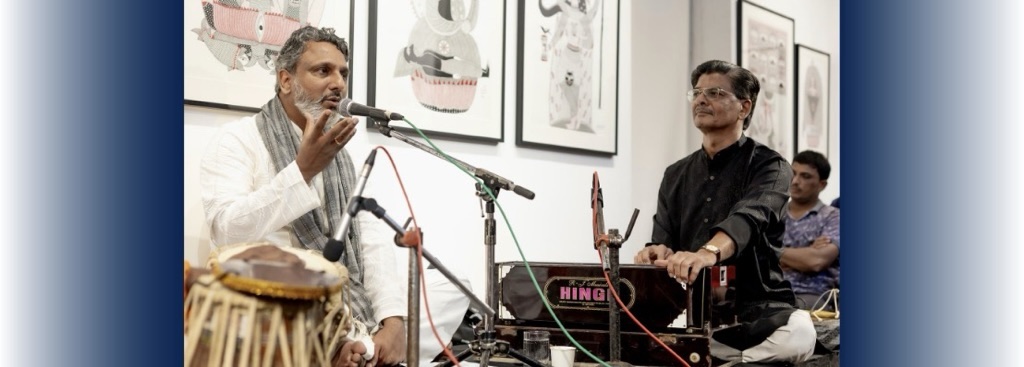
From Map to Compass: How Sāṃkhya and the Yoga Sūtras Clicked for Me

by Kealoha DeLuz

I’ve been diving deep into the Yoga Sūtra for the past six or seven years, and it’s been nothing short of life changing. Patañjali’s framework—the aṣṭāṅga, or eight limbs—offers such profound structure and guidance. For a long time, though, working with the Sūtras felt a bit like navigating without a complete map. I knew the direction, but the foundational why was sometimes elusive. Recently, I started exploring Sāṃkhya philosophy—the tradition closely related to Patañjali’s work—and suddenly, something clicked. Learning about Sāṃkhya helped me understand the roots of these ideas, where they originated, and how they fit together. It’s like having the complete blueprint in front of you. Once I understood the bigger picture, my practice with the Yoga Sūtras felt less like walking in the dark and more like navigating with a clear compass.

Sāṃkhya, often attributed to the ancient sage Kapila, is one of the oldest schools of Indian thought, and it serves as the ultimate philosophical bedrock for yoga. It’s not a religion; it’s a profound, methodical way of analyzing existence through a dualistic view of reality. Sāṃkhya posits two eternal, ultimate principles. First, there is Puruṣa: this is pure consciousness—the unchanging, eternal, and countless individual Selves (the soul). It is the silent witness, the observer of all creation. Second, there is Prakṛti: this is primordial matter—the active, creative principle. It’s the source of everything we can perceive and experience: our bodies, our minds, our emotions, and the entire material world. Prakṛti is dynamic and composed of three fundamental qualities, or guṇas: Sattva (lucidity, balance), Rajas (passion, activity), and Tamas (inertia, darkness). All the suffering we experience, according to Kapila’s wisdom, stems from one crucial error: our mistaken identification of our true self (Puruṣa) with the ever-changing products of Prakṛti. The goal is to achieve kaivalya, or liberation, by realizing the distinct and isolated nature of Puruṣa from the material world.

While Kapila’s Sāṃkhya provides this essential theoretical foundation—the what and the why—it lacks a specific, practical methodology for achieving liberation. This is precisely where Patañjali’s Yoga Sūtra steps in. Patañjali didn’t invent yoga; he brilliantly codified and systematized existing practices, using Sāṃkhya as his philosophical map. His famous definition of yoga, “yogaś chitta vṛtti nirodhaḥ” (Yoga is the stilling of the fluctuations of the mind), directly reflects Sāṃkhya’s principles. The “fluctuations of the mind” are a product of Prakṛti. By stilling them, one creates the necessary condition for discriminative knowledge to dawn, allowing us to experience the authentic, unchanging self, Puruṣa.

Patañjali’s eight limbs of yoga (Aṣṭāṅga Yoga) serve as the practical, step-by-step method to achieve this state. From the external practices of ethical living (yamas and niyamas) and physical postures (āsana) to the internal practices of concentration and meditation (dhyāna and samādhi), the entire path is an applied framework for realizing the metaphysical truth posited by Kapila. In essence, Sāṃkhya is the grand map of reality, detailing the landscape of consciousness and matter. At the same time, Patañjali’s Yoga is the GPS, providing the step-by-step directions to navigate that landscape and reach the destination of liberation. For me, understanding this enduring partnership has made my own journey with the Sūtras exponentially richer and clearer. It truly is a comprehensive and powerful system for self-realization.

Have you experienced a similar moment where understanding the philosophy made the practice “click”? I’d love to hear about it!

2026-03-17T10:36:13-07:00March 17th, 2026|

Living with Beginner’s Mind

Swami Ramananda

by Swami Ramananda

Experiencing the Infinite Possibilities of the Present Moment

Are we truly free to act with full awareness in the present moment — in harmony with our true nature and our interconnection with all of life?

This is the heart of our spiritual experiment.

To choose freedom means learning to respond to life without being driven by the hidden “shoulds” that may have taken root in childhood. Many of these inner directives operate quietly in the background of the psyche. They are so familiar and so deeply embedded that we rarely question them. Yet they shape our reactions, our decisions, and even our sense of self.

For example, do I hesitate to admit a mistake because I fear what others may think? If my self-worth depends on approval, I may subtly distort the truth to protect my image. If I am unconsciously governed by a need for security, I may rationalize behavior that compromises my integrity. These patterns are rarely deliberate. They arise from conditioning — habitual beliefs and thought forms accumulated over time.

Yoga offers us a compassionate laboratory for self-observation.

Even on the mat, we may notice the impulse to look good, to compare ourselves with others, or to measure our practice against some internalized ideal. We may judge a class as “good” or “bad” depending on how it matches our expectations. These reactions reveal how automatically the past overlays the present.

But Yoga also gives us another possibility.

During Hatha Yoga practice, we can move with attentive awareness, tuning into the raw sensations of the body without judgment. Instead of pushing toward an image, we respond with care to our actual capacity in this moment. In meditation, we practice disengaging again and again from the stream of thought we normally identify with. As the mind grows quieter, more focused and open, it begins to perceive clearly. We respond to events as they are, rather than through the colored lens of memory, hope, or fear.

Gradually, we learn to pause.

In that pause, we discriminate between anxious reactions triggered by stress and the deeper, neutral voice of Spiritual Consciousness. This transformation does not occur instantly. It unfolds over time through steady effort, patience, and a willingness to practice without demanding specific results.

When we begin to experience moments free from habitual thought patterns, something shifts. We see ourselves — and our relationship to the world — freshly. We feel our connection with others and with all of nature. Compassion arises naturally. Wisdom no longer feels forced; it flows from a deeper place.
With continued practice, even the subconscious mind is gently restructured. Old beliefs lose their grip. We are no longer compelled to repeat familiar patterns. Instead, we approach life with a sense of belonging, inner contentment, and wonder.

This is the essence of beginner’s mind.

To live with beginner’s mind is to approach each day without being dulled by routine or distracted by constant mental rehearsal. Habit has its place — it helps us tie our shoes or follow simple procedures — but it cannot guide us creatively through the living complexity of human relationships and life’s unfolding events.

Each day offers countless opportunities to delight in ordinary miracles: the rhythm of breath, the play of light, the presence of another human being. Yet our mental landscape is often crowded with plans, goals, and future projections. Leaning anxiously toward what we hope to acquire or achieve, we overlook the quiet completeness already here.

When we release that anxious leaning into the future and meet this moment fully, we discover something profound: the present is not lacking. It is alive with infinite possibility. It contains an inherent sense of wholeness that becomes evident when we feel our connection with all things.
Every moment invites us to begin again.

And in that willingness to meet life freshly — free from conditioning, open to possibility — we align with the true spirit of Yoga: living in awareness, acting in harmony, and experiencing the boundless richness of the present.

2026-03-05T16:49:22-08:00March 6th, 2026|Tags: , , , |

What This Moment Asks of Us

by Kamala Itzel Hayward

On the spring equinox, day and night become nearly equal for a brief moment—light and darkness meeting in balance—before the season turns and the Earth begins, unmistakably, to lean toward more light (for those of us in the Northern Hemisphere).

The equinox isn’t only a seasonal milestone. It’s also a teaching. It reminds us that balance is not a static achievement. It’s a temporary moment that arrives through a steady practice of re-centering.

These days, many of us are yearning for re-centering. We’re living inside a stark contrast: the season turning toward life-giving emergence, while we witness our communities experiencing upheaval, oppression, uncertainty, and exhaustion.

So I’ve been sitting with a question that feels both simple and urgent: What does this moment ask of us?

If you’d like to explore that question in community, I hope you’ll join me online on Sunday, March 22 from 11:00am–12:00pm PT when I’ll be hosting the Integral Yoga Institute’s Sunday Spiritual Talk (Satsang): “What This Moment Asks of Us: A Spring Equinox Satsang.”

We’ll begin by grounding in the equinox as a living metaphor—light and dark meeting in balance—and then turn toward the questions many of us are carrying in our bodies and hearts right now: how to stay steady in the midst of upheaval, how to respond to harm without hardening, and how to act with clarity without abandoning compassion.

Grounded in the wisdom of Integral Yoga and compassionate communication, this gathering will include shared reflection, contemplative inquiry, and guided practice. Together, we’ll explore how yogic principles of nonviolence and truthfulness, along with the cultivation of a calm, steady mind, can support us in responding to conflict and uncertainty with integrity—holding both clear action and compassionate care.

People of all faiths are welcome.

Wherever you are in your own movement toward balance, may this season help you to re-center yourself again and again, so your response to this moment can come from grounded awareness, compassion, and care.

2026-03-01T18:12:30-08:00March 2nd, 2026|Tags: , |

Seva – Dedication and Devotion in Action

Swami Ramananda

by Swami Ramananda

The saints and sages of many faiths are dynamic examples of how spiritual awakening is accompanied by a natural impulse to serve humanity. After experiencing the interconnection of all of life, many of these great beings were moved by a profound compassion to dedicate their lives to the relief of suffering. All of the many faith traditions also recognize the importance of Seva, or selfless service, as one of the primary means by which we grow on the spiritual path and experience that full awakening.

But the messages of our culture instill in us the illusion that we are all separate beings, each needing to pursue happiness as individuals. This easily leads to comparing ourselves and competing with each other for the things and achievements that seem to create a happy life. And the world economy feeds on this illusion by offering us happiness in the form of the marketplace—an endless variety of things to buy. Thus, many people find themselves living in a relentless cycle of earning and consuming that, sooner or later, leaves them feeling frustrated and incomplete, cut off from everything that really gives life meaning.

The teachings of Yoga offer a completely different paradigm. Serving others is seen as a unique spiritual path—Karma Yoga—a practice in which actions are performed with a focused mind, a caring heart, and no concern for personal gain. This intention can be incorporated into literally anything we do and it deepens as we become less dependent on the outcome of our efforts and experience a newfound freedom from tension and expectations.

What a relief it is for me to focus fully on my work projects, free of worry, knowing that agonizing over the results only diminishes my skills. Then it can be more like play. Sri Swami Satchidananda put it this way: “Do your best, leave the rest.”

Perhaps the most powerful way this practice develops is from the joy we derive from giving ourselves wholeheartedly in service to someone or some higher purpose. Many people who work in service of others find tremendous fulfillment in the act of serving, giving, or even praying for others. Such experiences go beyond theory—they enable us to feel a deep sense of connection and belonging, a purpose for living that is larger than ourselves, and the flow of love that is a natural expression of our true nature.

An equally powerful approach to seva is devotion, service as an offering to God. Since we don’t easily recognize the Divine in each other—and the idea of a spiritual consciousness is so abstract—people throughout history have found countless symbols, names, and forms to represent this ineffable Presence that dwells within everything. This form, be it a deity, spiritual principle like peace, or a picture of a saint, can help us cultivate a higher form of love. Love directed toward God in any form inspires us to feel protection and comfort, to access an ever-present Grace and inner strength, and rise above the illusion of separation.

Yoga offers techniques to cultivate this deep love, which are collectively known as Bhakti Yoga. These practices include chanting the names of the Divine to feel its Presence (Kirtan), creating an altar and making heartfelt offerings (Puja), and performing actions with reverence and devotion (Seva).

When we perform duties as an offering to a beloved personification of the Divine, we give our very best. In the Bhagavad Gita, Sri Krishna says, “Perfection in action is Yoga.” When we strive to see ourselves as instruments of the Divine—the hands of God at work in the world—we access and allow ourselves to be guided by an inner strength, much greater than our own. We let go of our personal desires without force or denial by willingly surrendering to a Higher Will.

The intention to serve a Higher Will inevitably leads us to serving our families, neighbors, and communities. As Mother Theresa beautifully experienced and taught, we serve God by serving the Divinity in each other, in all of nature. Seva is a practice, and if we practice seeing and serving God in all, we gradually erase the imaginary boundaries we have come to believe in.

2026-02-02T08:21:23-08:00February 2nd, 2026|Tags: , , , , , |
Go to Top