By PJ Church
The sound of a loved one’s heartbeat while your head rests against their chest. Releasing a slow, gentle sigh. The shimmering flow of a creek on a summer day. A mother’s bedtime lullaby. The rhythmic rush of waves on a sandy shore. These healing sounds are naturally woven into the fabric of our daily lives. Studies have even shown that expletives uttered in response to an injury reduce the experience of pain! It makes perfect sense then that much research and practice has gone into the art and science of sound, giving birth to the wide array of methods modalities we see today in the world of sound healing.
I first experienced a sound bath over a decade ago at the end of a gentle asana session, simple and beautiful, three crystal bowls singing the class into an immersive savasana. As we returned from deep relaxation, I remember thinking only five or ten minutes had passed and discovered the instructor had been playing for over half an hour. The experience was profound and left me with the resolve to study and begin sharing these kinds of experiences with others. As a musician, it felt natural, but it’s also worth noting that you don’t need to have any musical experience at all to quickly begin achieving results with simple tools like chimes, bowls, or gongs.
The science of sound is utterly fascinating. From vibrational resonance and measurable effects on brainwave entrainment to lower cortisol and blood pressure levels in sound bath recipients, the results are undeniable. While some of the research might be new, sound as a healing tool is not, with the use of singing bowls dating back thousands of years. And technology has brought new tools into being, crystal bowls for example, which weren’t even originally created for sound, but to grow crystals for computer processors!
Even more fascinating than the science of sound are the subjective experiences sound bath participants are often eager to share afterwards. In addition to the common experience of bliss, relaxation and timelessness, participants have described sensations of floating, seeing myriad colors and sometimes complex mandalas. Many have reported having improved sleep for weeks after just a single sound bath. More than once I’ve had a student describe feeling a profound sense of connection to a deceased family member and experiencing a healing release of grief. As much fun as it is to play these instruments for people, it’s seeing the meaningful results it brings to people’s lives that is the real nectar of the work.
While sound baths function well as an experience unto themselves, practitioners frequently find that these tools can profoundly enhance the practice of yoga, and yoga can in turn deepen the benefits of sound. Physical practices can help prepare the body to be more comfortable, relaxed and receptive. Pranayama combined with sound can, among other things, enhance the benefits of emotional regulation and focus. Sound itself is related to Pratyahara, which while commonly thought of as “withdrawal of the senses” does also refer to sensory consciousness in general and can aid us in the process of going inwards. Sound functions as meditation and helps to cultivate yoga as “citta vritti nirodha,” that deep inner stillness in which we can experience our true nature as pure awareness.
Sound, like yoga, is a flowing and open thing with myriad techniques, and it invites play and experimentation for guide and participant alike. There’s no one-size-fits all approach and there’s something there for everyone. In a sound bath, just like an asana class, it’s also helpful to practice non-attachment, to be open to having whatever experience presents itself in the moment, in the shimmering, healing magic of the moment.
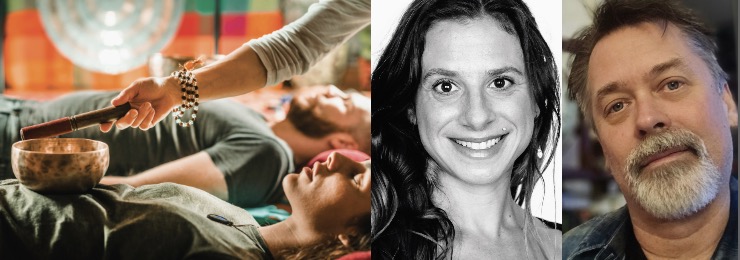
Join Rachel Goudey, Psy.D, C-IAYT and PJ Church, C-IAYT for Therapeutic Yoga and Sound Healing (In-Person) on Sunday, June 8th, 3:30 – 5:30 PM PDT
PJ Church, RYT-500, C-IAYT, has been a practitioner of yoga, mindfulness and related modalities for decades. Over the last 12 years, he has taught an array of studio classes, workshops and teacher trainings. Modalities that PJ teaches and practices include Hatha, Raja, Restorative, Vinyasa, Yin, as well as sound healing. When not teaching, he enjoys books, tea, travel, music, and being a grandparent.
Rachel Jennine Goudey C-IAYT, Psy.D. As an educator specializing in trauma work and embodied practices for nervous system integration, Rachel helps clients increase their capacity for joy and love in life through somatic movement, breath work, sound healing, self-reflection, and cultivating healthy life choices. Rachel brings years of mental health experience working with at-risk and underserved populations, integrating Eastern and Western practices to help clients move past symptom relief into true healing. She has brought holistic yoga programs and professional trainings on yoga for mental health into community mental health centers, hospitals and schools. Rachel’s aim is to guide individuals into states of peace and trust in their life’s story through the mind and body, create community, and bring the teachings and practices of yoga into various settings around the world. Rachel’s classes meet each student where they are at while still challenging them to reach new heights of self-realization, acceptance, and strength and flexibility, both on and off of the mat. She will push you to challenge yourself while also guiding you to listen to your body and intuition, teaching from a place of authenticity, passion and playfulness. To learn more about Rachel and her work visit racheljenninewellnessandyoga.com.