The Remnants

by Diana Meltsner

The Remnants

Memories of
friends, their generosity and obsessions,
children’s joy, their eyes filled with wonder,
the hurt and disappointment, mine and yours.

I see the pain of unreconciled differences
hanging over us like dark clouds,
doors close quickly and words disappear.

I see the pain of unwelcome gifts.
Receiving in awkward silence things, care, harm
you meant for me to have.

Turning towards the Light,

I can see the pain of holding on to what no longer is,
the good and bad.
Like trying to wear old clothes that no longer fit
or flatter.

How does one live with memories?
How does one let this pain pass through?

How does one move with changing seasons?
Fall turning into the winter while remembering
the warmth of the sun, or remembering
those simple times before the fire came
and devoured it all.

The Remnant,

I look at it and smile,
like seeing an old friend
I used to spend a lot of time with.
I choose to peel away a little from
this familiar pain.
The heaviness starts washing away,
eventually it dissipates.
I feel the fresh air and I hear myself sigh.
My body starts moving again.

We are all making it through,
bringing Light into darkness.
The clenching softens,
dawn’s cleansing power enters in.
The wild call comes as
the Soul shines through again so
hungry for life, taking us for a dance
once again.

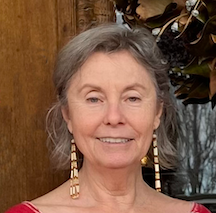
Diana Meltsner, E-RYT-500, C-IAYT has been teaching variety of classes and workshops since 2001 and since 2017 offers yoga therapy sessions privately and at Integral Yoga Therapy Clinic in San Francisco. Read her full bio here.

Jumpstart or deepen your meditation practice with Diana, Eric Gustafson and Swami Ramananda with a 21-day meditation challenge starting on Mon. January 9,  7:15 am – 8:00 am PT.  You can also join Diana for Guided Meditation Online every Sunday,  5:30 pm – 6:00 pm PT and every for Therapeutic Chair Yoga Class Online every Wednesday, 9:30 am – 10:30 am PT.

2022-12-30T18:25:51-08:00December 30th, 2022|

Teaching of the Month – Appreciation

by Prajna Piper

Appreciation in a spiritual sense is often talked about as a practice of cultivating happiness and joy in the good qualities of something, or of someone, or of taking joy in the happiness of others, of cherishing the wholesome. It’s a lovely quality on its own, and it’s part of a path that leads to a collectedness of mind.

In daily life, appreciation of the very small things, of a pleasant interaction, a beautiful sky or a breath of fresh air can bring a sense of satisfaction, of connection. A long time ago one of my teachers told me that when something lovely registered with me, to stop and rest with it for a moment and say to myself ‘this is enough.’ It’s a stop and smell the roses approach, but something in saying those words, this is enough, lets me take it in deeply. Instead of brushing it off before it’s even passed, and then letting the mind return to busyness or problem solving, I can pause to acknowledge and rest in an appreciation of the lovely. In the moment, this is enough.

It didn’t occur to me for a long time that this was something to cultivate in meditation as well, but in the last few years of my meditation practice, I’ve been purposely giving more attention to the pleasant moments as they arise, to appreciating them and resting in them. It turns out that there are a lot of them, right in there along with the aching body and the wandering mind. They’re often subtle, and that’s one of the reasons we need to train in appreciation. Because we’re survival oriented, the unpleasant will be louder, more attention grabbing than the pleasant. The itch or ache will feel more important than the pleasantness of the breath rising and falling. Just as we don’t have to believe every thought, we don’t have to trust every feeling. Because the unpleasant may feel more important than the pleasant doesn’t necessarily make it so. Long ago, I heard someone say that in meditation practice, first we learn to sit with the unpleasant and then we learn to sit with the pleasant.

Appreciation, in the dictionary, has a second meaning, which is “a full appreciation of a situation.” Interestingly enough, I think it’s this second meaning that allows us to be equanimous with both the pleasant and the unpleasant. This second type of appreciation supports the arising of compassion. For example, we don’t have to stretch our understanding far to appreciate the difficulty of sustaining attention in meditation. The Buddha called it swimming against the stream. We set out to do something that’s not usual and when we find ourselves not succeeding in the moment, we can appreciate the difficulty, regard ourselves with some compassion and start over. When we find ourselves thrown off in the difficult moments of daily life, it’s much the same. A full appreciation of a situation asks us to open our hearts and minds in understanding, a compassionate understanding that this is how it is now.

A full appreciation of the situation may not always be within our grasp, but we can appreciate that everything arises out of causes and conditions, myriad and complex, bringing both the lovely and the difficult into our lives. When appreciation of the lovely is cultivated, we have some ballast in facing life’s less than lovely situations. It’s a foundation for equanimity.

Recently I heard Christina Feldman, who was quoting the Buddha on appreciation (and I am paraphrasing here, since I was unable to find the quote itself.) “The quality of appreciation brings about joy, joy brings calm, calm brings happiness and in happiness the mind gathers in Samadhi.”

It’s quite a string of association. Appreciation brings joy. I think we can all get that. When we open to something in appreciation, there is a quiet joy that does, indeed, seem to lead to calm, to the peacefulness of a joyful heart. And the kind of happiness that flows out of calm is something else, something bigger than joy, it’s the kind of happiness that we meet in quiet moments of intimacy, in the natural world or in our sitting practice.

Last Sunday, we had the yearly teacher appreciation dinner at IYI. It was the first teachers’ dinner in two years and being together was a blessing for us all. It was a joy to see the people who came in person and a joy to see those who dropped in on zoom. The winter holidays are upon us, with all the annual joys and possible difficulties. This life, with its ten thousand joys and ten thousand sorrows, continues to unfold in mystery. If we can cultivate appreciation of the lovely it will help balance the difficult and bring us the kind of calm happiness where the mind gathers in Samadhi.

Prajna lives and practices at San Francisco IYI

2022-12-19T15:11:42-08:00December 19th, 2022|

The Magic Mat

by Tangela London-Henderson

“The Original Magic Mat is the innovative, game-changing product your die cutting has been missing. Swap out one of your plastic cutting pads for this sturdy self-healing pad and you’ll be amazed by the cleanest cuts you’ve ever achieved. Try the affordable, long-lasting Magic Mat today.”

As someone who enjoys crafting, the Magic Mat advertisement suddenly took on an entirely new meaning after experiencing yoga teacher training. I’ve seen this ad before, but I’ve never thought about anything more than crafting. The words began to resonate on a cellular level as I read and re-read this advertisement. The words like, innovative, game-changing, sturdy, self-healing, amazed, and cleanest cuts you’ve ever achieved all seemed to speak to how my mat  has become a key component to my transformation and self awareness……The Magic Mat.

Early April 2022, slowly coming out of the pandemic, with frustrations of the new normal setting in, I thought to myself, “Now is the time to do something “soul-y” for me.” I began to scour the internet looking for a yoga teacher training that resonated.

I filled out several applications, applied for multiple scholarships, had two interviews, and attended one open house. Funny thing, I was completely apprehensive about attending the Integral Yoga Institute Open House which was over 2,000 miles away from me. Little to my knowledge, this open house would be the beginning of an open heart, an open mind, and boundless connections. After meeting the instructors virtually, I immediately felt their authenticity and sense of commitment. I was glad I could attend virtually.

I can honestly say I had limited expectations going into this new chapter of life. I thought, “Well, I’ve done yoga before, like a ga-zillion times, so I know what to expect.” I had been introduced to yoga in 2015, when my son was diagnosed with Acute Lymphoblastic Leukemia. During that time, yoga was an opportunity to decompress from the stresses experienced as a full time caregiver of an ill child.

I decided I wanted to teach yoga in 2018,  after he had completed treatment.  I had no idea this training would push me far beyond my expectations and comfort zone(s). Just a little background about me – I’ve always been one to start new and exciting things but as soon as adversity becomes a real thing, I would flee without as much as a question of WHY? So, back to this push now known as yoga teacher training, it began like any other “classroom class”. You read the material, show up at the scheduled times, and discuss the previous and current readings. It wasn’t in the classroom where the action was happening, it was on my trusted turquoise mat, the one I bought four years prior, when the thought of yoga teacher training first became a thought. Life as I knew it, was transitioning into the life I longed for: dealing with emotions properly, removing the modifications of the mind, and seeing myself and others in the most positive light. I was starting to understand that yoga is not about self-improvement or changing others.  Yoga is about knowledge of self, self acceptance and accepting how people were able to show up in the world. With a beginner’s understanding of Jnana Yoga, I experienced a situation during yoga teacher training that left me trying to figure out how to truly and authentically accept people and their different ideologies. I couldn’t wrap my mind around others not viewing the training as I did: a journey of self knowledge and self awareness.

I realized through the teachings that it  isn’t about the people or others, it’s about my journey, my self awareness, and knowledge of self. It is not about forcing someone to accept, deal with, enjoy, or be a part of what I deemed knowledgeable, acceptable, or right. It is simply about navigating my path of knowledge….My own practice.

I not only learned how to breathe through situations and begin to heal but I learned so much about myself: how to trust me, to lean into my power within, and to be comfortable in transition. BIPOC training has provided me room to be my authentic self and has supported me when I wanted to quit, jump off the cliff, and give up. “Jumping off the cliff” became an inside joke whenever I decided not to stop, think, and breathe through a situation.

My reaction would often be the result of actions that took place in the past. There were multiple times I still reacted without awareness, but when I  truly embraced the teachings, things began to change. I was learning through the teachings of Bhakti Yoga that yoga is a constant devotion. On those days when I reverted to things of old, I slowly began to practice leaning on my faith and my relationship to the Creator to hold myself accountable for the right and wrong things I said or did and use that connection to transform my personal limitations. I was starting to understand that my everyday actions and words should be as a service to the Creator and not me. Yoga teacher training has given me so much more than asanas and breathwork. This training has given me daily living practices. These daily practices allow me an opportunity to remove “myself” from my daily activities or actions, and take away the “me first” aspect. I’m learning to simply do because I’m able, and not because I want the props, Karma Yoga in action.

I was able to practice and meditate on these exercises on what I now call my “magic mat.”  My mat was where I found innovation while meditating. The information and material covered in class became a game-changer while in silence on my mat. My mat has been a sturdy constant in my transformation. My mat has allowed self-healing to begin to take place. I truly have been amazed by the yoga teacher training, trusting the process, and staying the course. I used to joke with people and say, “You’ll never understand me because I’m cut from a different cloth.” Being able to experience my True Nature has allowed me to realize it’s not a joke, and my vitality is cut from a cloth with the cleanest cut you’ve ever achieved. I’m so thankful and grateful for the BIPOC Yoga Teacher Training, the awesome and well-versed instructors of the training, my new community of cohorts, and the way the universe showed me some LOVE and favor. I have learned that being pushed and bending but not breaking is actually one of my strongest assets. I’ve also learned that I can accomplish whatever I set my mind to, by being able to combat each negative thought with a positive one……..Pratipaksha Bhavana in action daily!

Forever Grateful.

Tangela London-Henderson lives in Memphis, Tennessee with her husband and children. She is a recent graduate of IYISF BIPOC 200-Hour Yoga Teacher Training and teaches a Hatha Level 1 Community Class at Glenview Community Center in Memphis, Tennessee. Tangela loves to create an inclusive, diverse, and supportive environment where all people feel welcome and safe. She is currently working on a children’s book about yoga and its lasting impact on her and her family.
Tangela studied at the University of Memphis, majoring in Communications. While studying at the University of Memphis, Tangela worked closely with area elementary schools to assist with literacy programs. Tangela’s passion is to provide equitable literacy resources for children within her community, no matter their race or household income. She has worked in Education as a Literacy Teacher Assistant and a tutor and mentor in the Nonprofit sector for many years.
2022-12-06T18:23:10-08:00December 6th, 2022|

Join Us in Promoting Diversity and Inclusivity in Yoga

by Rev. Kamala Itzel Hayward (she/her)

This is the story of a dream that I had in 2020. A dream that was made real thanks to the generosity of the Integral Yoga sangha and people like you—people who contributed to the Integral Yoga Institute San Francisco’s (IYISF) 2020 Giving Tuesday campaign.

It all started with my first Yoga teacher: my mother. I still remember her lavender tights. She still remembers that my favorite part of class was hissing like a snake as I raised up into Bhujangasana, cobra pose. I was five years old. And there was no reason to question that I belonged or that the peace and joy, love, and light that the students wished for everyone included me, regardless of who I was, what I looked like, or what my body could do.

My practice has changed a lot over the years—my muscles need more time to warm up and I don’t hiss in Bhujangasana anymore—but one guiding principle has remained the same: perpetuating systems of oppression and living in liberation are mutually exclusive.

The teachings of Yoga identify ignorance in all of its forms as the root cause of suffering. This ignorance includes systems of white supremacy, the gender binary, capitalism, and other concepts that lead to the systemic oppression of individuals. However, this truth isn’t always reflected in the spaces where Yoga teachers are trained or teach. Nor is it reflected on social media or in Yoga publications that elevate one stereotype of “the Yoga teacher” over all others in their cover images, stories, and advertisements: the young, flexible, thin, heteronormative white woman.

So in 2016, after I had been teaching Yoga for 6 years and practicing it for decades more, I was thrilled to hear Lakshmi Nair talk about her work. Lakshmi is the creator of the Satya Yoga Cooperative in Denver, Colorado, which is one of the first Yoga cooperatives for people of color.

I couldn’t help but wonder what it would be like to be a part of a Yoga community where I saw myself reflected in the eyes of my teachers. One that shared my values and my commitment to the liberation of all people, while also having in its deep awareness the context in which we are learning and practicing Yoga: a society that does not share that commitment.

A society that is actively operating contrary to that commitment.

A society that was built on—and, in so many deeply rooted and systemic ways—sustained by the oppression of people based on their race, class, gender, and more. A society that isn’t always aware of or willing to acknowledge its biases, privileges, and limiting beliefs, in direct contradiction to Yogic principles of self-awareness and self-study.

I wondered, “What would it be like to practice and learn in a community intentionally focused on Yoga as a tool for dismantling such beliefs and oppressive systems in service of the liberation of all beings everywhere?”

Then I had my chance.

Four years later, in 2020, I had the opportunity to attend the Black Orchid Yoga Teacher Training, a prenatal/postnatal Yoga Teacher Training offered by Melylah Smith, Alexandra Rossi, and Jane Austin. In an effort to address the devastating racial disparities in prenatal care, they offered the training completely free to Black women.

When I heard about it, I registered immediately. I, along with over 250 Yoga teachers, doulas, pregnant women, and more … all Black. Not only did I love the program, I fell completely in love with the community that was created in the process.

And I loved knowing that, together, we could make a difference to improve outcomes for Black newborns and pregnant Black folks everywhere on the level of body, mind, and spirit.

The experience was so meaningful and powerful, I knew that I wanted to be a part of bringing something like that to IYI. So I went to Swami Ramananda, Executive Director of IYISF, told him my idea, and asked if he’d be willing to bring it to IYISF. Without a moment’s hesitation, he said yes.

So under his leadership, Integral Yoga’s first 100% scholarship-based Black, Indigenous, People of Color 200-hour Basic Yoga Teacher Training was held in 2021.

When I imagined the training, I imagined a space where not only all of the students were BIPOC, but so were all of the lead teaching team members, the monitors, and the support staff. I also wanted there to be folks of a wide variety of ages, body types, genders, sexual orientations, and physical abilities. I dreamed of a teaching curriculum that acknowledged the ways in which the teachings of Yoga have been offered that have harmed others, and how we as teachers could do things differently. I wanted to talk about racism, the gender binary, capitalism, xenophobia, cultural appropriation, colonialism, spiritual bypass, intersectionality, and other forms of oppression that we and our students come to Yoga to heal from. And I dreamed of a panel of guest speakers composed of those BIPOC Yoga teachers who most deeply influenced me and my thinking of Yoga in this way.

Finally, I wanted to make the teacher training 100% scholarship-based, which allowed for the elimination of any financial barriers to participation. Many students paid for the training at the highest level–reinforcing the notion that, while money is a very real obstacle to participating in teacher trainings that many BIPOC face, it’s not the only obstacle. BIPOC also need safe spaces to learn, explore, make mistakes, ask questions, practice, and simply be. Trainings like these help to create those safe spaces. They also increase the diversity of Yoga’s teaching community, which allows for the creation of more inclusive and welcoming Yoga spaces, makes the teachings of Yoga more accessible, and affirms Yoga as a teaching and practice for the liberation of all beings everywhere.

It was a big dream. But it was made possible by the support of community members and Integral Yoga sangha members who contributed generously in the form of donations, spreading the word, and love and encouragement.

The 2021 training was such a success that we garnered enough community support again to hold a second in 2022. And, with your support, we hope to hold yet another.

Lead trainers in 2022’s teacher training program included Integral Yoga teachers Mia Velez, Nitika Achalam, and Rukmini Ando, and anatomy teacher Arturo Peale—and I had the honor of sharing the Yoga Sutras of Patanjali, one of the foundational historic texts on Yoga and Yoga philosophy. A team of Integral Yoga sangha members interested in serving as mentors, monitors, and guest trainers fell quickly into place, including Amanda Vigil, Belinda Todd, Cleopatra Altieri, Dharani Diana Diaz, Lorette Rasmi, Muktidevi Demafeliz, Oyámie Kali Ma’at, Ranjani Tutia, Renda Dabit, and Tinuola Bello. And other luminaries in the field of Yoga agreed to serve as guest presenters including Anjali Rao, Jay Miles, Lakshmi Nair, Mukunda Morozumi, Dr. Ram Bhagat, Saeeda Hafiz, Zawadi Nyong’o, and Shanna.

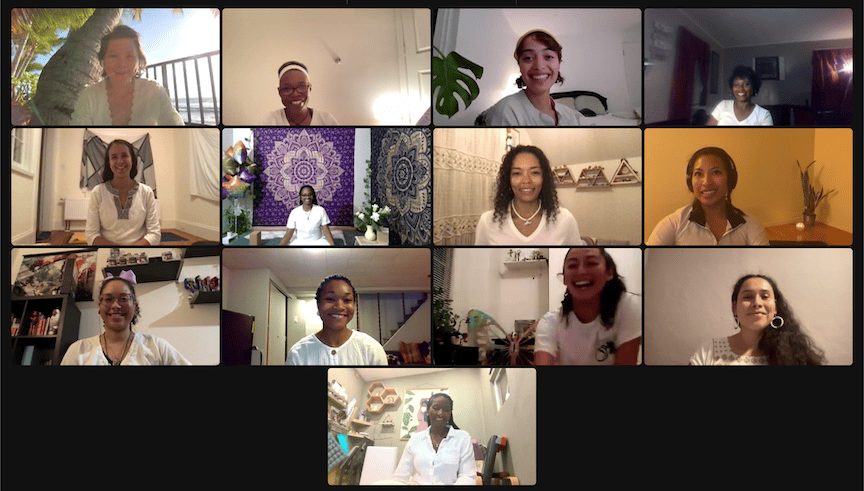
Congratulations to the 13 graduates of Integral Yoga’s second BIPOC teacher training: Aims Nirañjanā Villanueva-Alf, Cassiel Līlāvatī Owens, Erika Holmes Hamsini, Yesi Olivera, Monica Gupti Frangoul, Natya Bradford Niścalā , Rasheena Vimalā Vail, Selena Washington, Sienna Kateri, Simone Sadāgati Adkins, Tangela London-Henderson Jayasri, Tessa Kalyāṇī Anselm, and Tiarra Yamunā Gil.

May you all shine as examples of the glorious science of Yoga.

To voice your support please consider donating on GivingTuesday, November 29th, a global generosity movement that unleashes the power of radical generosity around the world:

  • Via our GoFundMe page for our BIPOC Yoga Teacher Training Scholarship Program.
  • Via Paypal to IYISF’s mission and future. We count on your generosity to make a difference in the San Francisco Bay Area and beyond.
  • Set up a monthly, recurring donation.

Thank you, Om Shanti, Shanti, Shanti.

2022-11-17T08:31:12-08:00November 17th, 2022|Tags: |
Go to Top