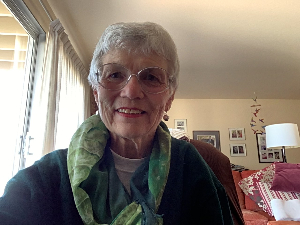
Student of the Month: Giovanna Ganga Pagano
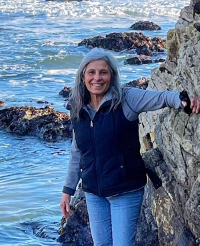
I am a psychotherapist living on the Mendocino coast with my landscaper partner, James, and our “family” of wild critters on our beautiful property. My 33-year-old daughter, Mandela, is currently hiking the Pacific Crest Trail and I am her resupply team!
I spend a lot of time in nature, which is easy here with the ocean, rivers, and redwood forests. I enjoy hiking and kayaking, harvesting wild mushrooms in winter, and making herbal tinctures and other products from local herbs I find. I also love to make jam and cordials from our wild berries and fruit in the orchard. I’m definitely a foodie and enjoy making healthy and delicious things in my newly remodeled kitchen! I’m also a hand drummer, and for many years James and I played for a Congolese dance class and studied/practiced weekly with an Afro-Cuban group. I also study and practice Italian with a weekly group.
I first discovered yoga at age 17 in the summer of 1969. When in the local drugstore , a 95-cent paperback book caught my eye. It was called “Richard Hittleman’s Guide to Yoga Meditation.” I bought it and taught myself everything in the book. So I had a daily practice. Then I found “Yoga, Youth, and Reincarnation” by Jess Stearn, and learned from that one too.
When I started to look at colleges, one of my criteria for choosing one was that they offer yoga; I found this at Boston University and had my first live teacher! After college I discovered the Boston IYI and began to attend classes and workshops there. I moved to Maui in 1978 and there was nothing there, no yoga at all, let alone Integral Yoga. I practiced on my own sporadically during those years.
I found myself in San Francisco for a short time in the mid-80s, and took classes at IYISF. I was fortunate enough to see Swamiji at the Scottish Rite Center just before I left San Francisco for Mendocino. I was pregnant and I asked Swamiji to bless the baby, and he did! It worked! (LOL)
Then I arrived in Mendocino; no IYI here, either. I learned Vipassana meditation and tried other yoga classes, but Integral Yoga was always “home,” so I had to rely on audio cassettes (yes! tapes!) and later on DVDs, as well as my old books and notes. Wanting to deepen and organize my practice, I finally had the opportunity to go to Yogaville in the fall of 2017 to take Basic Teacher Training. This was one of the highlights of my life! They gave me the name Ganga.
After “yoga school,” I practiced daily and seldom missed a day. When the pandemic hit, I was so happy to discover the online classes! These classes have expanded and deepened my practice and enriched my life beyond measure. Having a sangha is so important!
There are so many benefits of my Integral Yoga practice. For me, remembering who we are and the connection and sacredness of all things is primary. Having grown up Catholic, the main phrase I took away was “God is everywhere in everything.” I found that the Integral Yoga phrase “Truth is One, Paths are Many” resonated with me in the same way. It all spoke to the Oneness, the miracle of existence, the connection, that we are both creator and creation.
And of course I also do the practice to maintain and increase my strength, flexibility, and balance (which seems to get more important all the time!), calming and centering, and because it feels so good! Also, I use yoga interventions in my psychotherapy practice, especially pranayama. Service has always been important to me.
Thank you to all my teachers: Snehan, Ramananda, Divyananda, and more. Thank you to all my teachers from Yogaville! Thank you to Swami Satchidananda for bringing this incredible practice to us!
Jai!
Ganga