About prajna

This author has not yet filled in any details.
So far prajna has created 103 blog entries.

Teaching of the Month – Remembering with Gratitude

by Swami Ramananda

The month of May has inspired us to remember with gratitude the many blessings we have received in this lifetime. Gratitude is a practice that never gets old and once we begin reflecting, there is no end to what we have to be grateful for. Examining our lives with gratitude softens the heart, keeps life’s challenges in perspective, inspires humility and reminds us that we are part of a much bigger picture than our limited minds can comprehend.

One of the primary reasons this practice came to our minds is the occasion of Mother’s Day. For most of us, our mothers made great sacrifices in giving birth and nurturing us through childhood. All of us can likely feel gratitude as well for other important mentors and mother-like figures whose love had a great impact on our growth.

This time of year, it’s also easy for us to feel gratitude and awe at the array of Spring flowers and trees that are blooming around us. Everywhere we look, there is this incredible beauty that we are blessed to witness.

In the United States, May also includes Memorial Day, honored on the last Monday of the month as a way of remembering the military personnel who died defending our country. But we are also choosing to remember all those ancestors, elders and leaders who sacrificed in countless ways to give us the opportunities we now enjoy.

We can feel an even more profound gratitude for the saints and sages of all the faiths who have been for us a source of inspiration, embodying the spiritual Light and serving as role models. We offer our respect and gratitude as well to the Yoga masters who dedicated their lives to transmitting the teachings and practices that have impacted our lives so deeply.

Practicing gratitude can transform our lives even more fully if we embrace the understanding that each day provides us with another opportunity to learn and grow, to expose and heal our limitations and selfishness, and open our hearts wider to love more fully.

Gratitude need not be only an inner appreciation of life’s journey and all we’ve received. It calls for a response. Whenever we sincerely pause to contemplate the magnitude of our blessings and feel the resulting fullness in our hearts, we will naturally be inspired to give back in some way, to serve those in need. Gratitude becomes an underlying source of nourishment that inspires us to act with generosity and courage by embodying peace and compassion, spiritual values that are so desperately needed in our world.

You can join Swami Ramananda for his weekly, in-person/online (hybrid) Mixed Level Hatha class every Saturday at 9:30am PT. And join him for the 4-day Yoga Vacation and Retreat: Community, Contentment, Compassion May 27-30 in Bolinas.
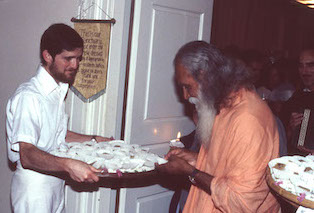
Swami Ramananda is the Executive Director of the Integral Yoga Institute in San Francisco and a greatly respected senior teacher in the Integral Yoga tradition, who has been practicing Yoga for over 45 years. Ramananda offers practical methods of integrating the timeless teachings and practices of Yoga into daily life, and transforming the painful aspects of human experience into steps toward realizing one’s full potential.
He leads beginner, intermediate and advanced level Yoga teacher training programs in San Francisco, and offers a variety of programs in many locations in the U.S., Europe and South America. Ramananda co-developed the Stress Management Teacher Training program with Swami Vidyananda, has trained many teachers to bring Yoga into corporate, hospital and medical settings, and has taught mind/body wellness programs in many locations. He is a certified Yoga therapist and founding board member of the Yoga Alliance, a national registry that supports and promotes yoga teachers as professionals. He is a co-founder of The Spiritual Action Initiative (SAI) which brings together individuals committed to working for social justice for all beings and for the care and healing of our natural world. His warmth, wisdom and sense of humor have endeared him to many.
2022-05-16T21:06:59-07:00May 16th, 2022|

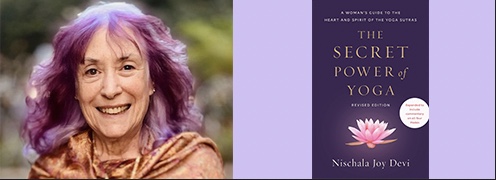
The newly revised Secret Power of Yoga – Can the Yoga Sutras Bestow Spiritual Powers?

by Nischala Joy Devi

Please join Nischala and the sangha in Celebrating the Revised Secret Power of Yoga on Sat. May 21 @ 11:00 am – 12:00 pm PT


The Secret Power of Yoga, new edition, allows a complete road map to experiencing the totality of Yoga as the union of the body, mind, and spirit which propels us to higher states of consciousness and ultimate realization of the Divine Self.

Observing how Yoga has changed the world, I cannot help but wonder how the world has changed Yoga. As the plethora of Yoga studios and communities formed, they focused mainly on serving the physical body. The calling was great; Strengthen and balance the body —- that is what people knew, and that is where the needs seemed to be the greatest. Many of the transformational physical benefits were touted, and the studios that sprang up were brimming to capacity.

While I hold a great respect and awe for the physical body, my real love was for the sacred wisdom teachings of Yoga. The connection to the inner teachings led me to wonder if those beginning Yoga knew the treasure hidden within the path that they were treading. If they delved a bit deeper, an approach more expansive than the mind could imagine would be revealed. It fueled my intention to provide a more accessible pathway for any seeker who chose Yoga as set forth in the scriptures. Their reward would be not just a healthy and strong body but liberation itself.

With this inspiration, the first edition of The Secret Power of Yoga, a woman’s guide to the heart and spirit of the Yoga Sutras, was born.

When I originally wrote this tome, I made certain choices and adaptations, hoping to make it accessible to many. The compromise in dealing with such a comprehensive sacred text was to translate and comment on Books I and II and to summarize Books III and IV. Books I and II are by tradition the most widely expounded upon and gives even the most zealous student plenty to study and assimilate. They are the foundation of Yoga wisdom and practice, important for all dedicated students and teachers.

Books I and II will always be the gold standard for describing the basis of Yoga. They simply and elegantly unveil the sacred teachings, while establishing our perception that when consciousness unites, our birthright as a Divine Being is revealed. To the delight of many, this supreme wisdom is enhanced by an abundance of practices, allowing the knowledge gained to be experienced.

Books III and IV contain the most esoteric aspect of the Yoga Sutras, and because of this, they tend to be less accessible to the basis of a spiritual quest. Venturing into books III and IV presumes that certain experiences and understandings explained in the earlier padas have provided the foundation to build upon.

Rather than assuming, “Oh, I already know the Yoga Sutras, Let’s go on,” query, “If I continue to practice, what is in store for me?” It is a way of cajoling the mind to practice.

For those of us that are students of the Yoga Sutras, it is not only a scripture of great wisdom, but a guidebook for everyday living. We are inspired daily to uphold our idea of Self, ensconced in Sutra I.2, Yoga Chitta Vritti Nirodaha, Yoga is the uniting of Consciousness in the Heart. In the midst of our daily life, we may encounter an action or thought that drives us in the opposite direction of our peaceful nature, recalling Sutra I.2 can gently remind us of who we really are.

Another example could be the practice of the great Yogic virtue, Ahimsa, reverence, and love for all, as the pinnacle of our life. When we garner the intention to honor others, holding them in high esteem, we inadvertently unveil our own divine nature.

The Yoga Sutras are broad in their appeal – they encompass expressions of wholeness, uniting body, mind, and emotions. This union then leads us to the realization of the Divine Spirit.

Approaching Books III and IV, we are issued strong cautions. Some great teachers do not speak about or even expound upon these teachings. Do they fear us getting caught in the enticing powers?

With all the concerns about powers or siddhis, the third book, Vibhuti Pada has the greatest number of Sutras of any of the other padas! Kaivalya Pada continues to extol the siddhis, before it valiantly attempts to describe our indescribable true nature.

We have all experienced these siddhis, spiritual powers at some time or another. Can you recall a time when you heard the phone ring a moment before it actually rang? Or perhaps you thought of a friend you had not seen for some years, and to your surprise, the next time you checked email and there is a sweet message from that same friend.

These occurrences, while infrequent, might be deemed mystical, yet they are cocooned within our deeper understanding. The siddhis often come spontaneously but also can be cultivated by intention and practice. The powers transport us to exalted levels of understanding inching us closer to knowing our true divine Nature.

For this understanding to blossom, take an inward, intuitive approach to all the Sutras, especially Pada III and IV. Be still and query the parts you don’t understand – rather than pushing them away. When we sit quietly, the unfamiliar concepts reignite the consciousness and the deeper meanings are revealed.

It is now time to unveil the Secret Power of Yoga in its entirety – To incorporate the more advanced and esoteric teachings as a vital part of our spiritual practice and growth.

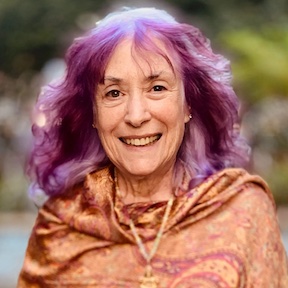
NISCHALA JOY DEVI is a masterful teacher and healer. For many years she has been highly respected as an international advocate for her innovative way of expressing Yoga and its subtle uses for spiritual growth and complete healing. Her dynamic delivery and deep inner conviction empower each individual, allowing the teachings to expand beyond boundaries and limitations of any one tradition enabling her to touch people’s hearts.

She was graced to spend over 25 years as a monastic disciple with the world-renowned Yogiraj Sri Swami Satchidanandaji, receiving his direct guidance and teachings. She also was blessed with teachings from great Yoga masters in US, India and worldwide.

Originally trained in Western medicine, she began to blend western medicine with Yoga, offered her expertise in developing the yoga portion of The Dean Ornish Program for Reversing Heart Disease, and co-founded the award-winning Commonweal Cancer Help Program. Her book “The Healing Path of Yoga,” and her Abundant WellBeing Audio Series expresses these teachings.

With her knowledge of yoga and her experience in assisting those with life-threatening diseases (particularly people with heart disease and cancer), she created Yoga of the Heart®, a training and certification program for Yoga teachers and health professionals designed to adapt Yoga practices to the special needs of that population.

She is now dedicated to bringing the Feminine back into spirituality and the scriptures, in her book, The Secret Power of Yoga, a woman’s guide to the heart and spirit of the Yoga Sutras and Secret Power of Yoga Audiobook Nautilus Book Silver Award Winner! Understanding the need for more love and compassion in today’s world, The Namaste Effect: Expressing Universal Love through the Chakras, her most recent book, explores a heart-centered way of living through the mystical chakras. abundantwellbeing.com

2022-05-11T15:36:37-07:00May 10th, 2022|

New Beginnings

By Mia Velez

Last Friday, I attended the New Beginnings Writing Group with Susan Ford, and it inspired me to write this blog!  I like to write.  It sorts out ideas floating in my mind.  When I write, I can complete my thoughts without interruption and be thorough with/in my expression.  I can open into new depths of ideas that I wouldn’t have reached without writing them down.  Even though the process is wrought with all sorts of obstacles; –  time, focus, grammar rules, etc. – it is always rewarding to finish a piece.  Over the last two years however, I had not finished one.  I had pages of half finished articles.  Actually, “half-written” would have been an accomplishment.  It was more like a smattering of words.

Writing had started to feel like a source of anxiety.  I don’t know when that had started, but I could figure out why:  I want to be a writer.  There, I’ve said it!  Even as I wrote that last sentence, I could feel anxiety and intimidation lurking in my psyche.  Can I really do it?

The first thing I did was tell someone.  So I could hear myself say it out loud, and also to see the reaction of the other person.  The next thing, by recommendation of a friend, was to look for a writing group.  And what a coincidence, IYI was offering one!

I met Susan Ford when she assisted at my teacher training.  She was supportive, kind and always had the right things to say to turn a situation around.  She was just the same leading the writing group.  We did some writing exercises – something I had never done before.  I felt a little silly doing them sometimes, but I was trusting the process.  After all, I was the one who was intimidated by writing.  After each exercise, we wrote, and the block that often stood in the way of my words disappeared.  Sure my first assignment was clunky, but with each new exercise, the words started a flow.

I’d like to share one of the pieces I produced at the workshop.  I’m really happy that I went and I am excited to return..hoping to see the friendly faces that were there.  Certainly, it does feel like a new beginning.

Susan chose a poem by W.S Merwin, Black Cherries, a snapshot of time for the author.  Goldfinches fluttering, the petals on the ground, the shadows of the day as he eats his cherries.

“Remember this,” he says.

The writing prompt asked: What does the poem evoke?

I think W.S Merwin might be letting on how satisfied he is with his life.  Not just at that moment, but that particular period of his life when he wrote the poem.  Appreciating the details of his surroundings like they are time capsules or landmarks of his whole human experience at the time of its writing.

I too, have intentionally created landmarks of time when I take in the moment to “remember this.”  Everything is framed to be remembered:  the lines on the floor, the light resting on objects just so, and more importantly how I’m oriented in this particular moment of life:

A six year old racing with the moon.

A teenager outsmarting god.

An exhausted young mother wrestling with her toddler.

I remember and become that person again.

Please join Mia on Wednesdays for her online Mixed Level Hatha class, Wednesdays at 7:30 AM – 8:30 AM PT

And you can also join Susan Ford’s monthly, online workshops: New Beginnings Writing Group on Fri. May 13 @ 4:00 pm – 6:00 pm PDT. This

Mia Velez entered the Integral Yoga Sangha in 2016 through the kitchen by helping to cook Thursday community lunches and silent retreat meals. In 2018 she certified as an Integral Yoga teacher to learn more of the IYI approach and be part of the lineage. Mia is a disciple of the Moy Yat Ving Tsun Kung Fu lineage and is highly influenced by her martial arts training. After completing her first 200 hour teacher training in 2008, she began to see undeniable parallel in Yoga and Kung Fu. When she began teaching Kung Fu in 2014, she incorporated Yoga insight and principles in her classes. Her goal in teaching is to connect with the students and to facilitate a safe space for exploration and self inquiry. Yoga and Kung Fu is integrated into her daily life as a mother, a preschool teacher, and an advocate for gender, race and class equality through multiple non-profits groups.

Mia is also a trainer for the IYISF 200-Hour BIPOC Yoga Teacher Training. Please read more on our website to learn about, apply or support this scholarship based training. This training is an effort toward dismantling the structural and institutional racism that exists in wellness communities, and to increase diverse representation in Yoga. If you are BIPOC and would like to become a certified Yoga instructor, we encourage you to apply today!

2022-10-12T08:41:01-07:00May 2nd, 2022|

Study

by Swami Vimalananda

This is the second of three articles on Kriya Yoga

Svadhaya: Sacred study of The Divine through scripture, nature, and introspection

       The Secret Power of Yoga by Nischala Joy Devi

Study, focusing on introspection, reminds us of our goal of peace, happiness and unconditional love, and the pathways to obtaining our goal.

To begin, we must be able to observe and acknowledge our ego attachments.  Then, we can cultivate the ability to step back and analyze what our attachments are.  Over time, we replace our attachments with selflessness.

As we engage in introspection we begin to observe our inner peace.  As Sri Gurudev stated, “Whatever the thought is, if there is no selfishness behind it, it can never really bring pain to the person concerned. The result is neither pain nor pleasure, but peace. Seeing this truth, we should analyze all our motives and try to cultivate selfless thoughts. That is our first and foremost duty.”

It is the letting go of the delusion that happiness is found somewhere in the world. The letting go creates space for us to step back from the fray, and then everything can become a study of why our peace is disturbed.   After completing several years of instruction on roleplaying from a therapist.  I remember when the therapist asked me, “Did you see that dynamic?” Roleplaying trains us to see people’s emotional dynamics.  But instead of observing the person from a place of peace, I went along on the person’s ride. I cannot tell you how many rides I have been on.

How do we step back? I feel that meditation is the most direct way of developing that practice. With concentrating on one thing and letting all the other thoughts go we begin to realize that we are not our thoughts. We learn that we have the capacity just to watch our thoughts go by without the need to hook on to any of them. We then can take this witness out into the world where we observe that we are independent and that our peace and happiness are not reliant on anything outside of ourselves. We are the source of our own peace and happiness. We discover that our peace and happiness can be maintained even with all the world’s dramas. As Sri Gurudev stated, it can be like watching a movie. We hiss at the villain, laugh with the clown, cry for the lost love of the heroine, feel all the emotions expressed in the movie. But when the movie ends, we get out of our seats and walk out of the theater, knowing it’s just a drama. We enjoy it as such.

As we step back we begin to realize that all the dramas can easily go on without us.  All those movies, poems, writings, songs, etc. lamenting love, clinging to the delusion that love and happiness can be found in the world.

Growing up, my father was distant, I remember very clearly trying to win my father’s love, feeling that, if I could, I would be happy. A relative let me see her therapist.  The therapist said to me, “First of all, no one ever takes my advice. But here it is – you are hitting your head against a stone wall, you will never feel loved by him. You also do not need his love to have a good life.”  I was about 12 or 13 years old when I was told that, I’d say, looking back, I was in my 30’s before I truly got the message.

I remember a skit on TV about four generations of men going to Hawaii together. On the last day one of the wives said “Let’s take a photo for a keepsake of having all four generations of men together.”  The men lined up from the youngest to the oldest. Just as the photo is being taken, the youngest looks to his father, the father looks to his father so on to the great grandfather, who is looking straight ahead oblivious to the desires of the other men in the family. With meditation and introspection, we can begin to observe that however convoluted it may appear, ultimately the reason for many of people’s interactions is just the desire to be happy and feel loved.

Usually, though, we feel caught up in the world’s interactions, as if we are standing close to a train going by. We see it as a blur of lights, different colors, experiencing a fierce wind and loud noise, causing us to feel imbalanced. As we step back, we see our peace is not contingent on the world’s interaction.  We see the train for what it is, the locomotive, the caboose, and everything in between, and we stay balanced.

With detachment from thinking that happiness and peace is found outside of ourselves we begin to see the causes and effects more clearly.  As Ram Das stated in a title of one of his books “It’s All Grist for the Mill”.  We observe everything as a learning situation to realize our own freedom from the world’s dramas.

With the practice of stepping back we begin to feel more grounded and centered. We are capable of meeting adversities with more ease. We realize we are independent from the world and that true happiness and peace have always been in our hearts. We see the world clearly, and because of our own stability we see how the soothing balm of love is the way to be of service to others; others who are finding their way to peace and happiness.

Please join Swami Vimalananda for Satsang: Interfaith Celebration of Easter and Passover, The Divine Mystery on Saturday, April 16 from 5:00 – 6:30 pm PDT. People of all faiths are welcome.

Swami Vimalananda Ma, RYT500, is an Integral Yoga sannyasi – monk. She has been involved with Integral Yoga since 1971 and Director of the San Francisco Integral Yoga Institute from 1992-2011. She specializes in teaching yoga philosophy and spiritual counseling.

2022-10-12T08:41:32-07:00April 10th, 2022|
Go to Top